
The reason many hosts and platforms respond to takedown notices is the DMCA safe harbor. Understanding it helps you write notices that get results.
This page is general information, not legal advice. In the United States, the DMCA gives online service providers protection from certain copyright liability for user content, if they meet conditions, such as having a process for takedown notices and removing infringing material when notified.
That is why most large hosts and platforms have forms and respond to valid notices: complying helps them keep their safe harbor protection.
As a content owner, safe harbor explains why platforms respond to your notices so quickly. They protect themselves by acting on valid notices, which means a complete notice gives you leverage.
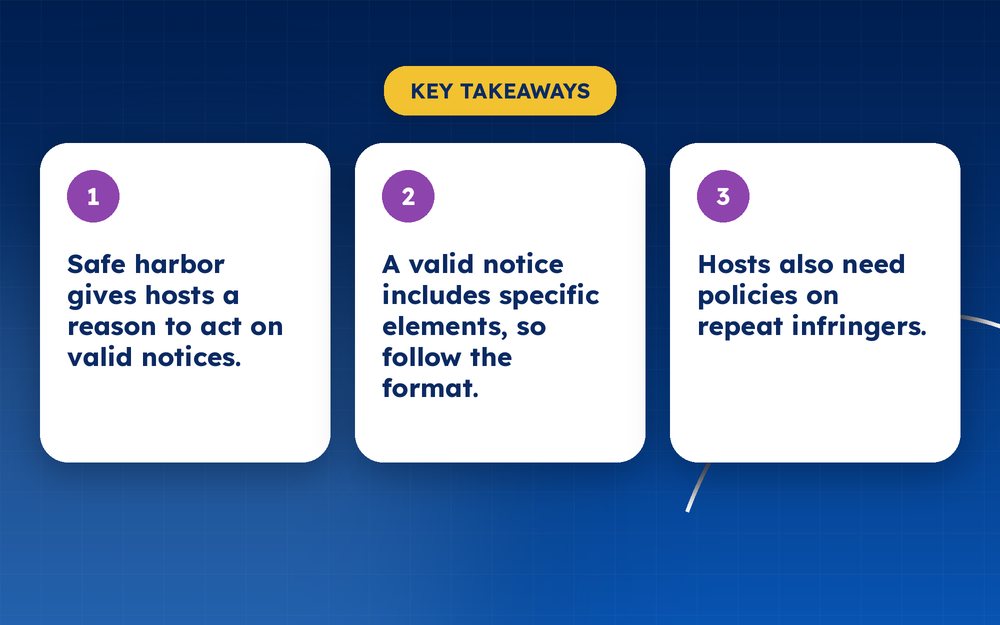
- Safe harbor gives hosts a reason to act on valid notices.
- A valid notice includes specific elements, so follow the format.
- Hosts also need policies on repeat infringers.
How to use it, step by step
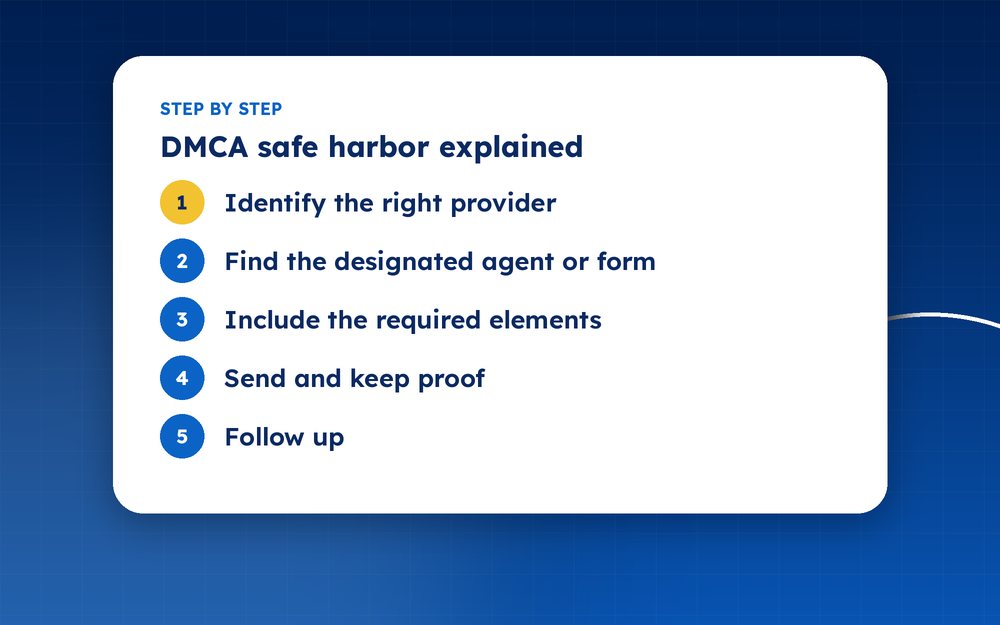
- Identify the right providerFind the host or platform with the infringing content. Work out which company hosts, delivers or lists the content. Platforms, hosts and search engines may all be relevant.
- Find the designated agent or formProviders publish contact details or a form for notices. Providers who want safe harbor protection register a designated agent or provide a form. Look for it on their copyright page.
- Include the required elementsIdentify the work, the infringing links, your contact details, the good faith statement, the accuracy statement and your signature. A valid notice usually names the work, lists the infringing links, gives your contact details, states good faith and accuracy and is signed.
- Send and keep proofRecord when you sent it. Send by the specified method and keep a copy, with the date and any reference number.
- Follow upIf no response, escalate to upstream providers. If nothing happens after a few days, send a polite follow-up quoting the first notice.
- Track repeat infringersLog repeat offenders and mention them in notices. Providers are expected to deal with repeat infringers under their policy. Keep a record of repeat reports.
- Respect the processDo not send false or abusive notices. Do not send notices for content you do not own, or without checking for exceptions. False claims can have consequences.
What safe harbor requires of providers
In general terms, providers must not have actual knowledge of infringement or must act quickly once informed, must not profit directly from it where they have control and must have a process to handle notices and repeat infringers. Details are legal and fact-specific.
Why this matters to you
If a host ignores a valid notice, it risks losing protection for that content. This gives notices weight, but you should not threaten providers. Clear, accurate notices are enough.
Limits of safe harbor
It is a US framework. Other countries have their own rules, and many providers follow similar processes globally. Some sites ignore notices entirely, which is why you escalate to upstream providers.
Abuse of notices
False notices can have legal consequences. Send notices only for content you own or are authorised to act for.
What a typical case looks like
A creator finds her course on a file hosting site. She finds the designated agent on the site's copyright page and sends a complete notice listing 20 links. The provider removes the files within two days, and she records the repeat infringer's account. When the same account uploads again, she cites the earlier notice and the account is suspended.
Her complete first notice and record keeping paid off later.
Common mistakes to avoid
Do not omit required elements. Do not send notices to the wrong party. Do not assume every site follows the DMCA. And do not make threats in notices.
How a specialist can help
A specialist team can prepare and send well-formed notices to sites and their upstream providers. We are not a law firm and cannot give legal advice. Email us in confidence.
Frequently asked questions
What is safe harbor?
It is a legal protection in some countries for providers that act on valid takedown notices, reducing their liability for user content.
Does it apply everywhere?
The DMCA is a US law, but many providers apply similar processes globally. Other countries have their own rules.
What should a notice include?
Identification of your work, the links, your details, statements of good faith and accuracy and a signature.
What if the provider ignores my notice?
Follow up, then escalate to other providers and search engines.
Can I send notices for content I do not own?
No. Notices should only be sent by the owner or an authorised representative.
Is this legal advice?
No. It is general information, and laws differ by country. For advice on your situation, speak to a qualified lawyer.
Need help with this?
Every situation is different. Email us the details in confidence and we will reply with an honest assessment of what can be done.
Contact us by email DMCA takedown serviceThis guide is general information, not legal advice. DMCA Reputation is not a law firm.
Related guides
DMCA, Defamation or Privacy Request: Which Removal Route Fits?
DMCA, defamation or privacy request: which removal route fits? How to match your problem to the right route, what each needs and why the wrong route fails.
Read the guide · 4 min
GDPR Erasure Request: Template and Steps
GDPR erasure request template and steps: who can use it, how to write a request, what to expect, deadlines and what to do if a company refuses. General information.
Read the guide · 4 min
How to Send a DMCA Takedown Notice (With Template)
How to send a DMCA takedown notice: what to include, who to send it to, a free template, counter-notices and common mistakes.
Read the guide · 5 min