
Not every case involves nude images. Sometimes ordinary photos from your social media are copied onto adult sites and forums, with captions that falsely suggest something sexual. This is still abuse, and it can be removed.
Pictures taken from public profiles can be reposted with your name and misleading captions on adult forums, tube sites and image boards. They can damage your reputation and invite harassment even though the pictures themselves are harmless.
Platforms treat this under rules on harassment, personal information, impersonation and copyright. You can use several routes at the same time.
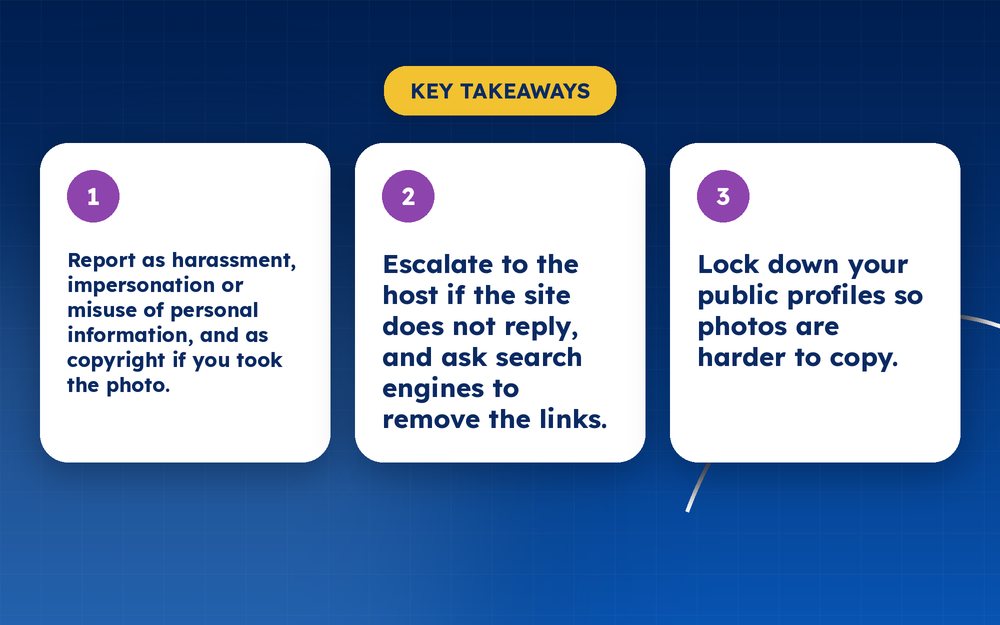
- Report as harassment, impersonation or misuse of personal information, and as copyright if you took the photo.
- Escalate to the host if the site does not reply, and ask search engines to remove the links.
- Lock down your public profiles so photos are harder to copy.
How to remove them, step by step
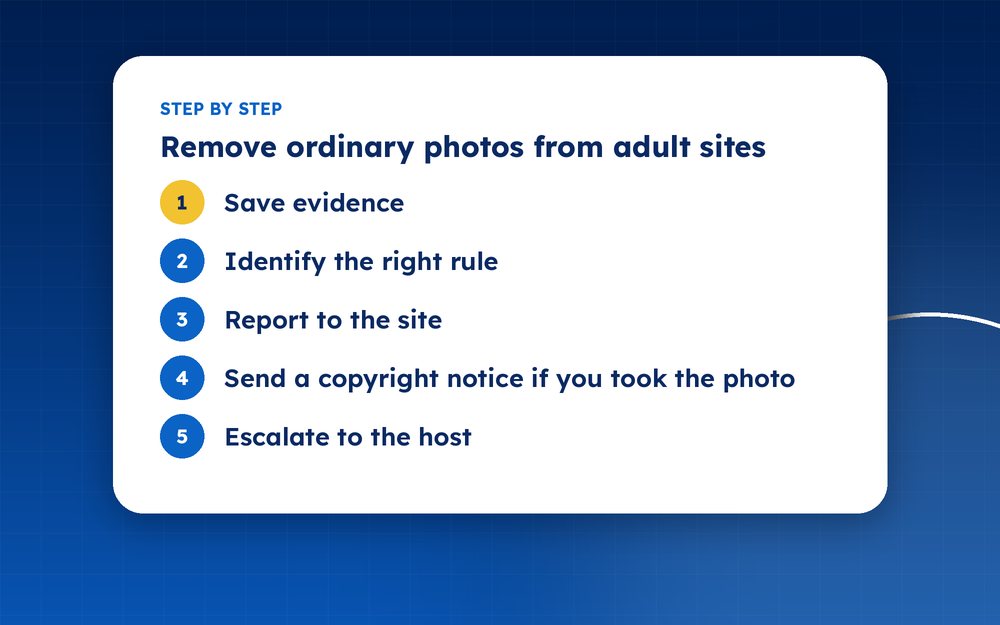
- Save evidenceScreenshot the page, caption, username and web address. Capture the page showing the photo, any caption and the address. Save it privately.
- Identify the right ruleDecide whether the post is harassment, impersonation, misuse of your name or copyright infringement. You can cite more than one. Look at the site's rules. Many ban non-consensual content or photos posted with identifying details.
- Report to the siteUse its report form or abuse email and state that the photo was taken from your profile and posted without permission. Use the site's report form and say that the photo is of you, was posted without consent and is placed in a sexual context.
- Send a copyright notice if you took the photoIf you own the photo, a takedown notice to the site and its host can be effective. If you took the photo yourself, a copyright notice can be a strong route. Include proof that it is yours.
- Escalate to the hostIf the site ignores you, find the host and send a notice to its abuse contact. If the site ignores you, write to the host with the same evidence.
- Ask Google and Bing to remove linksRequest removal of results that show your name together with sexual content or harassment. Ask Google and Bing to remove search results that link to the page.
- Review your own privacy settingsMake social profiles private, remove old public photos and check your tagged photos. Review your public photos and tighten privacy to reduce the chance of repeats.
Why this happens
Photos are scraped from social profiles by people who want attention, revenge or to sell content. Some are posted as part of a harassment campaign. Others appear on sites that collect and mislabel photos of women for views.
Whatever the reason, you did not cause this by having a public profile, and the removal route does not depend on why it happened.
If the photo is edited or AI-generated
If the image has been altered, report it as a fake that falsely shows you. Many platforms and search engines have specific rules for synthetic sexual content, and the process is similar to other non-consensual image reports.
Protecting your name afterwards
Monitor your name for new posts and set alerts. Build positive results such as a professional profile, which can help push down any remaining harmful pages.
How long it can take
Responses vary. Larger sites with clear policies may act within days, while small forums and scraper sites can take weeks or ignore reports until the host or search engine becomes involved. Keep a log of each request and date, follow up politely after a reasonable wait and escalate in order: site, host, then search engines.
Persistence matters more than any single message. A short, factual report repeated and escalated tends to work better than one long complaint.
What a typical case looks like
A woman learns that ordinary holiday photos from her social account were posted on an adult forum with her name. She saves the page and reports it under the site's consent rule. She also sends a copyright notice because she took the photos. The forum removes them in four days, and Google removes the results. She tightens her privacy settings and checks again in a month.
Using both consent and copyright routes gave her two grounds for removal.
Common mistakes to avoid
Do not reply to the poster or comment on the thread. Do not assume that a small site is harmless, since it can feed larger sites. Do not delete your own profiles in a panic, because you will want them to prove the photo came from you.
How a specialist can help
Dealing with many small sites and scrapers at once is time-consuming. A specialist team can find copies, send the right notice to each site and host, and monitor for new posts. We cannot promise every copy will be removed, but we will be honest about what is realistic. Email us in confidence.
Frequently asked questions
Can I remove a photo that was publicly available?
Yes. Being public on one platform does not give others permission to repost it with misleading or sexual context.
Do I need to own the copyright?
Not for harassment or impersonation reports, but owning the photo gives you an extra route.
What if the site is hosted abroad?
You can still contact the host and search engines. Response times can vary, but many hosts act on clear reports.
Will removal stop reposts?
It reduces them, but you may need to keep reporting and monitoring.
What if my name is in the caption?
Ask for the whole page to be removed and ask search engines to remove the link.
Should I involve the police?
If you are being harassed or threatened, yes. A report can support action against the person responsible.
Need help with this?
Every situation is different. Email us the details in confidence and we will reply with an honest assessment of what can be done.
Contact us by email NCII removalThis guide is general information, not legal advice. DMCA Reputation is not a law firm.
Related guides
What to Do If You Were Filmed Without Your Consent
What to do if you were filmed without your consent: secure evidence, report to police and platforms, get recordings removed and find support. A clear, practical guide.
Read the guide · 4 min
How to Remove a Sex Tape From the Internet
How to remove a sex tape from the internet: find every copy, report to sites and hosts, use copyright and non-consent routes, clean up search results and block re-uploads.
Read the guide · 4 min
How to Remove Non-Consensual Intimate Images (NCII), Step by Step
How to remove non-consensual intimate images (NCII): reporting, StopNCII.org, Google removal, legal options and support. A step-by-step guide.
Read the guide · 4 min