
Adult sites and tube sites vary a lot. Some respond quickly to reports of non-consensual content, others are slow or ignore them. Knowing how to report, and how to escalate, makes the difference.
If your private images or videos have been uploaded to an adult website without your consent, the site's own report process is the first route. Reputable sites have policies against non-consensual content and usually have a dedicated form or email address for it.
Less reputable sites may ignore you. In that case you can go to the company that hosts the site, to payment or advertising partners, and to search engines. This guide shows you the order to try.
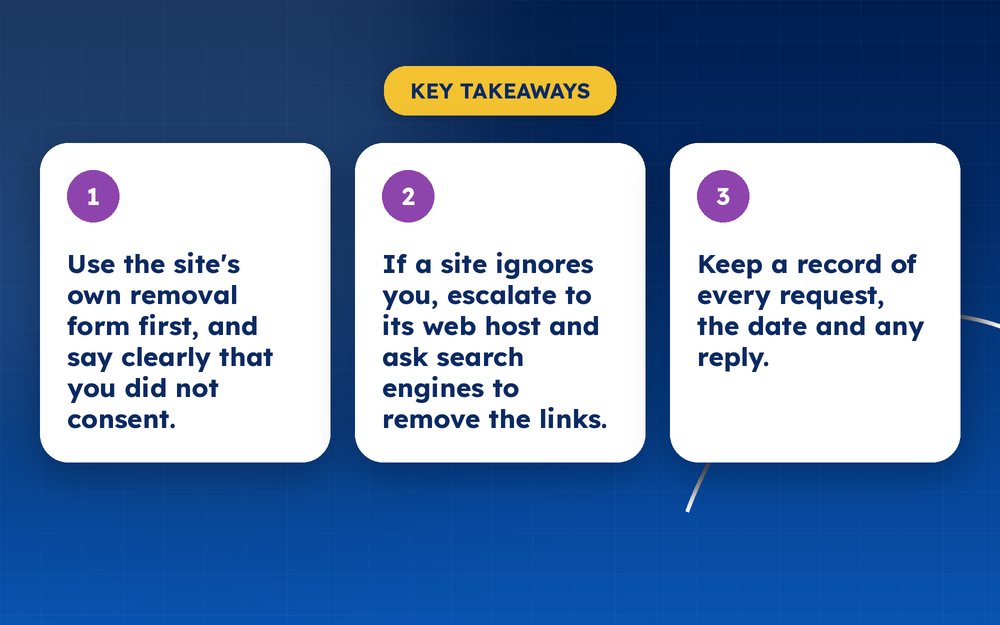
- Use the site's own removal form first, and say clearly that you did not consent.
- If a site ignores you, escalate to its web host and ask search engines to remove the links.
- Keep a record of every request, the date and any reply.
How to report, step by step
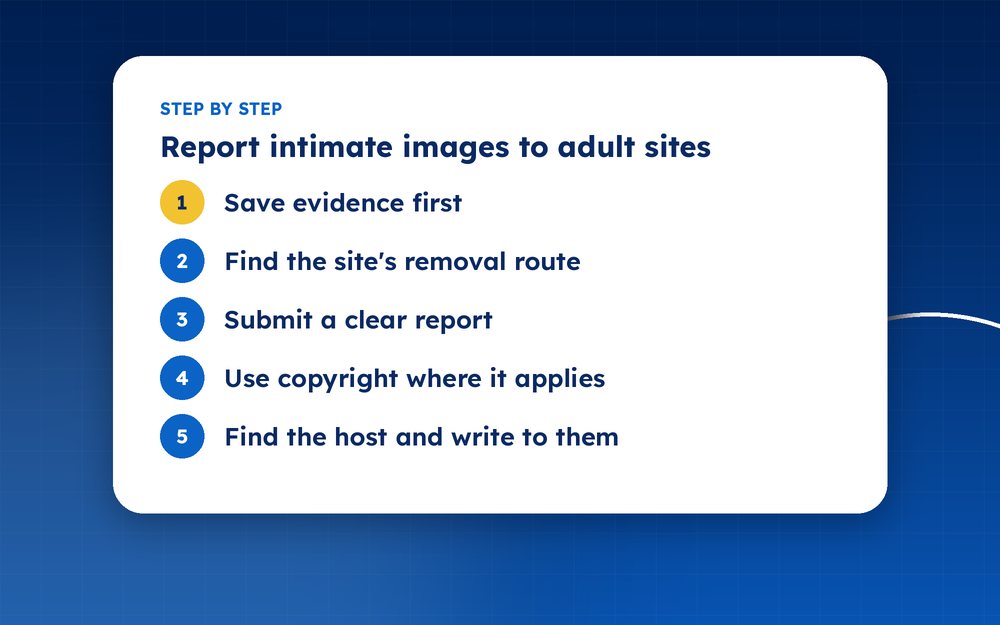
- Save evidence firstTake screenshots of the page, the title, the web address and any comments. Save the video link. Do this before you report, because content may vanish and leave you with no record.
- Find the site's removal routeLook for links such as Content Removal, Report, Trust and Safety or Legal near the footer. Many sites have a dedicated non-consensual content form.
- Submit a clear reportSay that the content was uploaded without your consent, give the exact link, and explain briefly that you are the person shown. Add identifying details only if the form asks for them.
- Use copyright where it appliesIf you recorded the content yourself, you may own the copyright. A takedown notice to the site and its host can be an additional route.
- Find the host and write to themIf the site does not respond, look up who hosts it and send a notice to the host's abuse contact, with the same evidence.
- Ask search engines to remove the linksEven if the site stays online, you can ask Google and Bing to remove the links from search results.
- Follow up and keep recordsNote the date and reference for each request. If a site says it removed the content, check that it is gone and that copies have not been uploaded elsewhere.
Spotting reputable and unreliable sites
A reputable site has a clear removal policy, a named contact and a response time. A site with no contact details, no policy and constant new domains is harder. For these, the host, payment services and search engines are often more effective than writing to the site itself.
What a strong report contains
A good report is short, specific and polite. It names the exact page, states that you are the person shown, says clearly that you did not consent to the content being published, and asks for removal. Add your screenshots if the form allows, and a contact email that you check regularly. Avoid long explanations or emotional language, which can slow processing down.
If the site asks for identity proof, ask what it will do with the information and how long it will keep it. Some sites let you blur or crop identity documents so that only the necessary details are visible.
Escalating when a site does not respond
After a reasonable wait, send a second notice to the site and a first notice to its web host, citing your earlier report. Hosts generally have abuse contacts and a policy against illegal content. You can also ask Google and Bing to remove the links from their results, which reduces how easily people find the content while you continue to chase the site.
If your images were uploaded by a stranger or a former partner
It does not change how you report. Platforms usually act on the report whether or not you know who posted the content. If you know who did it, include that detail only if it helps, and think about whether to involve the police.
Common mistakes to avoid
The most common mistake is reporting before saving evidence, which leaves you with nothing to show if the page disappears. Another is sending long, emotional messages that bury the key facts. A third is paying anyone who promises to remove content without explaining how. Keep reports factual, keep copies of everything and be cautious about services that guarantee results.
How a specialist can help
Dozens of adult sites can mean dozens of separate forms, hosts and follow-ups. A specialist team can identify the copies, send the right notices to the right parties and chase the replies so you do not have to deal with the sites yourself. We cannot promise every site will comply, but we will give you an honest assessment. Email us in confidence.
Frequently asked questions
Will adult sites remove content if I ask?
Many reputable sites do, once they confirm the content was uploaded without consent. Others are slow. If a site refuses or ignores you, escalate to its host and to search engines.
Do I need to prove who I am?
Some forms ask for identification or a photo to confirm you are the person shown. Ask what the site does with that information, and send only what it needs.
What if the site says I signed a release?
Check the details. If you did not agree to the release, or the images were shared outside what you agreed, say so clearly and ask for the release to be produced.
What if the video has been copied to many sites?
Report each copy separately and use search engine removal requests. A monitoring service can help find new copies as they appear.
Is the copyright route always available?
Only if you own the copyright, for example because you recorded the content. It is an extra tool, not a replacement for the non-consensual content route.
How do I stop re-uploads?
Hash-matching tools such as StopNCII.org help on participating platforms, and monitoring helps find new copies elsewhere.
Need help with this?
Every situation is different. Email us the details in confidence and we will reply with an honest assessment of what can be done.
Contact us by email NCII removalThis guide is general information, not legal advice. DMCA Reputation is not a law firm.
Related guides
How to Remove Intimate Images From Reddit
How to remove intimate images from Reddit: report the post, contact moderators, ask Reddit to act, remove search results and stop re-posts. A practical step-by-step guide.
Read the guide · 4 min
How to Remove Intimate Images From X (Twitter)
How to remove intimate images from X (Twitter): report the post and account, save evidence, ask for search removal and stop reposts. A practical, step-by-step guide.
Read the guide · 5 min
How to Remove Non-Consensual Intimate Images (NCII), Step by Step
How to remove non-consensual intimate images (NCII): reporting, StopNCII.org, Google removal, legal options and support. A step-by-step guide.
Read the guide · 4 min