
Review attacks by competitors are common in crowded markets. The best response is evidence, patient reporting and a steady stream of genuine reviews.
Competitors may post fake negative reviews on your profile, post fake positive reviews on theirs or ask others to attack you. They sometimes use fake accounts and appear to be customers.
Platforms have rules against conflict-of-interest reviews and coordinated manipulation. Show clear patterns and avoid retaliation, which breaks the same rules.
Competitor attacks tend to follow a pattern, with new accounts, matching wording and links to rivals. Proof of a connection is powerful, but even a clear pattern can be enough for a platform to act.
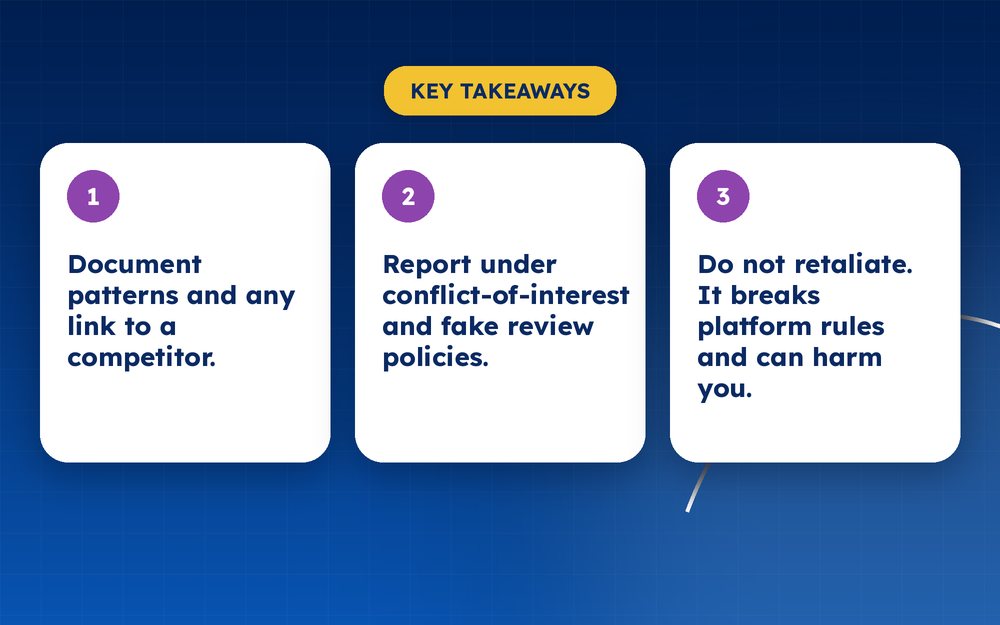
- Document patterns and any link to a competitor.
- Report under conflict-of-interest and fake review policies.
- Do not retaliate. It breaks platform rules and can harm you.
What to do, step by step
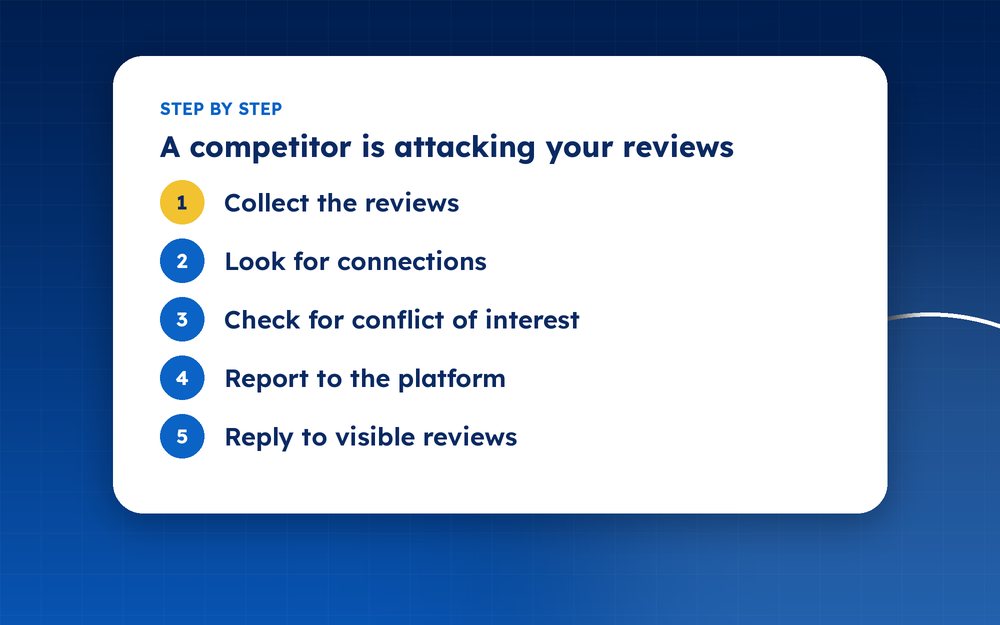
- Collect the reviewsRecord text, date, account and any links. Capture each review, with account name, date and link. Note anything odd about the accounts.
- Look for connectionsCheck timing, wording and reviewer history for signs of coordination. Check whether the accounts or reviewers link to a competitor, such as the same names, locations or shared reviews.
- Check for conflict of interestSee whether the reviewers have links to a competitor. Platforms treat conflicts of interest and fake engagement seriously. Check which rule applies.
- Report to the platformUse the conflict-of-interest and fake review routes with a short summary. Report each review with your evidence, including the pattern and the possible link.
- Reply to visible reviewsRespond politely, and invite genuine customers to share their experience. Reply politely to the most visible reviews to show customers that you take them seriously.
- Encourage genuine reviewsAsk happy customers for honest reviews. Ask genuine customers to review, in line with platform rules.
- Consider regulators and legal adviceFor clear schemes, regulators may help, and a lawyer can advise on other options. For serious, persistent attacks, a lawyer can advise on claims, and consumer or competition regulators may be relevant.
Why retaliation backfires
Posting fake reviews on a competitor's profile breaks the same rules, can lead to penalties and may create legal problems. It also muddies your own evidence. Stay on the right side of the rules.
Evidence that points to a competitor
Reviews that mention a competitor by name, reviewers who also review the competitor's business positively, or comments that reveal inside knowledge can suggest a link. Keep your evidence factual and avoid publicly naming anyone.
Regulators and consumer law
Fake reviews can breach consumer protection rules in many countries, and regulators have taken action on review manipulation. Reporting may be an option if you have strong evidence.
Staying visible and credible
Keep your profile complete, respond to reviews and keep collecting genuine feedback. A strong base of real reviews limits the effect of an attack.
What a typical case looks like
A dentist notices a sudden series of negative reviews from accounts that have only reviewed his practice and one rival. He saves them, notes the pattern and reports them for conflict of interest. Google removes most of them within two weeks. He replies to the rest and asks patients to review. A lawyer explains what further steps exist if the attacks continue.
The link to the rival was not proven, but the pattern was enough for most removals.
Common mistakes to avoid
Do not accuse competitors publicly. Do not post fake reviews. Do not ignore the issue. And do not delay evidence collection.
How a specialist can help
A specialist team can analyse patterns, prepare reports and follow up with platforms. We are not a law firm and cannot give legal advice. Email us in confidence.
Frequently asked questions
Can I prove a competitor is behind the reviews?
Sometimes, but even without proof, a pattern is often enough for platforms to act.
Can fake competitor reviews be removed?
Often yes, if they break rules on fake engagement or conflicts of interest.
Can I take legal action against a competitor?
Possibly, but it is costly and depends on proof. A lawyer can advise.
Should I reply to the reviews?
Briefly and politely.
How do I protect my rating?
Collect genuine reviews and monitor.
Is this legal advice?
No. It is general information, and laws differ by place. For claims or court action, speak to a qualified lawyer.
Need help with this?
Every situation is different. Email us the details in confidence and we will reply with an honest assessment of what can be done.
Contact us by email Google review removalThis guide is general information, not legal advice. DMCA Reputation is not a law firm.
Related guides
Why Your Google Reviews Disappeared and How to Get Them Back
Why your Google reviews disappeared and how to get them back: spam filters, profile changes, suspensions, policy removals and the steps to request restoration.
Read the guide · 3 min
How to Remove a Rating With No Text on Google
How to remove a rating with no text on Google: why star-only ratings are hard to remove, what policies apply, how to flag suspicious ratings and how to offset them.
Read the guide · 3 min
How to Remove a Google Review: A Complete Guide for Business Owners
How to remove a Google review: what Google will remove, how to report it, how to appeal and what to do if it stays. A guide for business owners.
Read the guide · 6 min