
Finding your course for sale on someone else's website is infuriating. Because they are making money from your work, you have strong levers: the host, the payment provider and search engines.
Resellers copy courses and sell them cheaply, often with copied sales pages. Some also steal your branding and testimonials. They rely on hosts, payment services and ads, and each can be reported.
Start by documenting everything, because these sites change quickly.
When a site sells your course, money is moving, which gives you more levers than with a free download. Payment providers, hosts and search engines can all be asked to act.
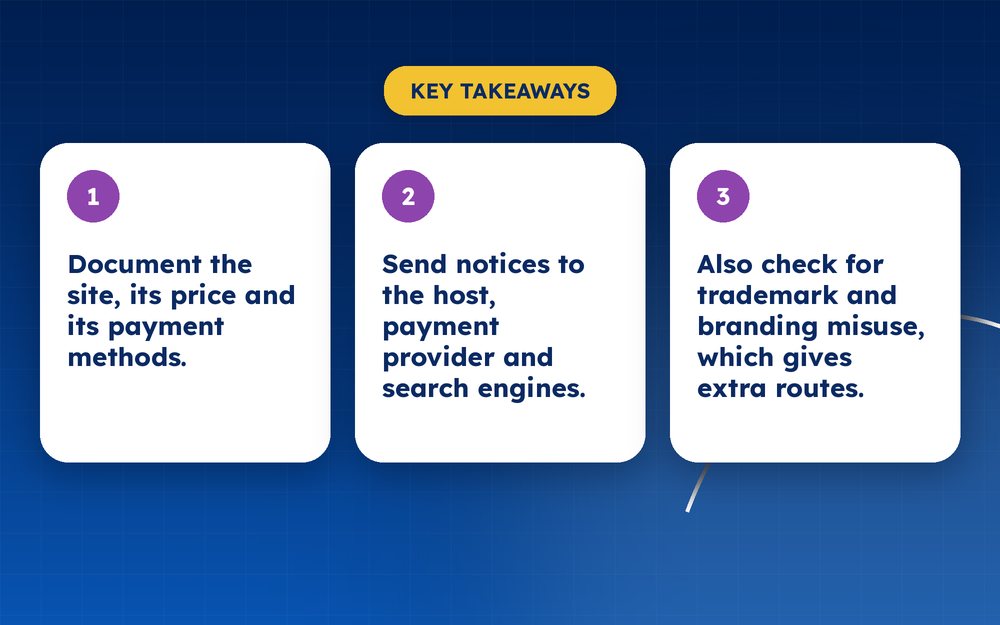
- Document the site, its price and its payment methods.
- Send notices to the host, payment provider and search engines.
- Also check for trademark and branding misuse, which gives extra routes.
What to do, step by step
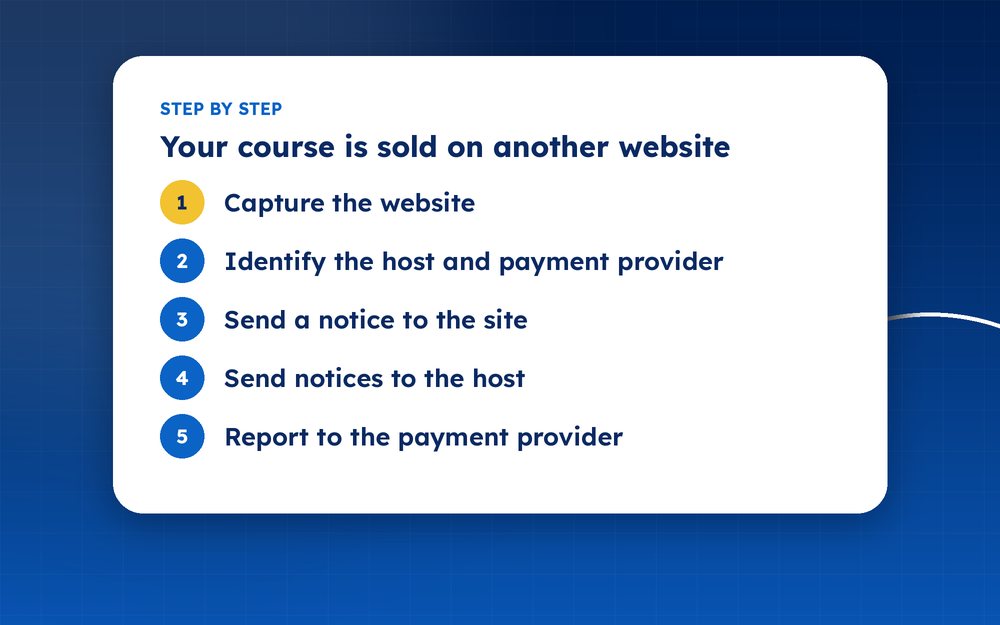
- Capture the websiteTake screenshots of the sales page, the price, your course name and any copied material, with dates. Save the sales page, price, checkout page and any terms. Capture the site's contact and payment details.
- Identify the host and payment providerLook up who hosts the site and which payment services it uses. Look up the host, content delivery network and payment services the site uses. Note each one.
- Send a notice to the siteUse the contact or DMCA page, with your proof and the links. Send a notice to the site if it has a contact, but expect that some will ignore it.
- Send notices to the hostUse the hosting company's abuse or copyright contact. Send complete notices to the host and delivery network, with the sales page and your proof.
- Report to the payment providerMany have rules against selling infringing content. Tell the payment provider that the site sells infringing content. Many providers have policies against it.
- Ask Google to remove linksSubmit copyright requests for the sales pages. Submit the sales pages to search engines for removal, to reduce traffic.
- Check ads and social pagesReport any ads or social accounts promoting the site. Check adverts and social pages for the same site, and report those too.
Why the money trail matters
A reseller who loses payment processing or hosting often loses the business. Reports to payment providers with clear evidence can be very effective, because providers have their own risk rules against infringing content.
When the site copies your branding
If the site uses your logo, name or sales copy, you may also have trademark or brand infringement claims. This gives you extra reporting options with hosts and registrars.
Do not buy from the site
Buying your own course to prove it is available can create complications and gives the seller money. Screenshots of the listing are usually enough.
Legal options
For serious or large-scale reselling, speak to a lawyer about claims and cross-border options. We are not a law firm and cannot give legal advice, but removal work can proceed in parallel.
What a typical case looks like
A trainer finds her course on a site selling it for a fraction of the price. She saves the pages and finds that it uses a content delivery network and a payment processor. The network suspends the site after her notice, and the payment provider closes the account. She submits the links to search engines and reports two adverts.
Cutting off the payments mattered as much as taking the pages down.
Common mistakes to avoid
Do not email the seller demanding payment. Do not delay evidence collection. Do not ignore the payment provider. And do not assume a small site is harmless.
How a specialist can help
A specialist team can document the site, send notices to the host, payment provider and search engines, and monitor for new reseller domains. We cannot promise every site will go, but we will be honest about what is realistic. Email us in confidence.
Frequently asked questions
Who can stop a site selling my course?
The host, content delivery network, payment provider and search engines can all act on valid reports.
Should I contact the site first?
You can, but many do not respond. Use other routes in parallel.
Can payment providers help?
Many act on reports of infringing sales. Provide evidence.
Will the site return?
It may. Monitor and report quickly.
Can I claim compensation?
That is a legal question. Speak to a lawyer.
Is this legal advice?
No. It is general information. For claims or court action, speak to a qualified lawyer.
Need help with this?
Every situation is different. Email us the details in confidence and we will reply with an honest assessment of what can be done.
Contact us by email Piracy monitoringThis guide is general information, not legal advice. DMCA Reputation is not a law firm.
Related guides
What to Do When Someone Sells Your Course by Direct Message
What to do when someone sells your course by direct message: collect evidence safely, report accounts, notify platforms and payment providers and warn your audience.
Read the guide · 3 min
How to Handle Leaks From Kajabi, Teachable, Thinkific and Udemy
How to handle leaks from Kajabi, Teachable, Thinkific and Udemy: what the platform can do, how to trace buyers, send notices and protect your course going forward.
Read the guide · 3 min
How to Send a DMCA Takedown Notice (With Template)
How to send a DMCA takedown notice: what to include, who to send it to, a free template, counter-notices and common mistakes.
Read the guide · 5 min