
Some Canadian businesses think of suing over a false review. It can be possible, but anti-SLAPP laws in several provinces make weak claims risky. This is a general overview, not legal advice.
In Canada, defamation law is mostly provincial. Several provinces, including Ontario and British Columbia, have anti-SLAPP rules designed to stop lawsuits that target public-interest expression early. A business that sues over a review can face a motion to dismiss, and may be liable for costs if it loses.
Whether a review is public-interest expression depends on the facts. A solicitor or lawyer in your province can explain how the rules apply. Meanwhile, platform reports and good replies are often faster and cheaper.
Canadian provinces differ in their rules, and anti-SLAPP laws apply in some but not all. That is why a local lawyer matters more here than almost anywhere else.
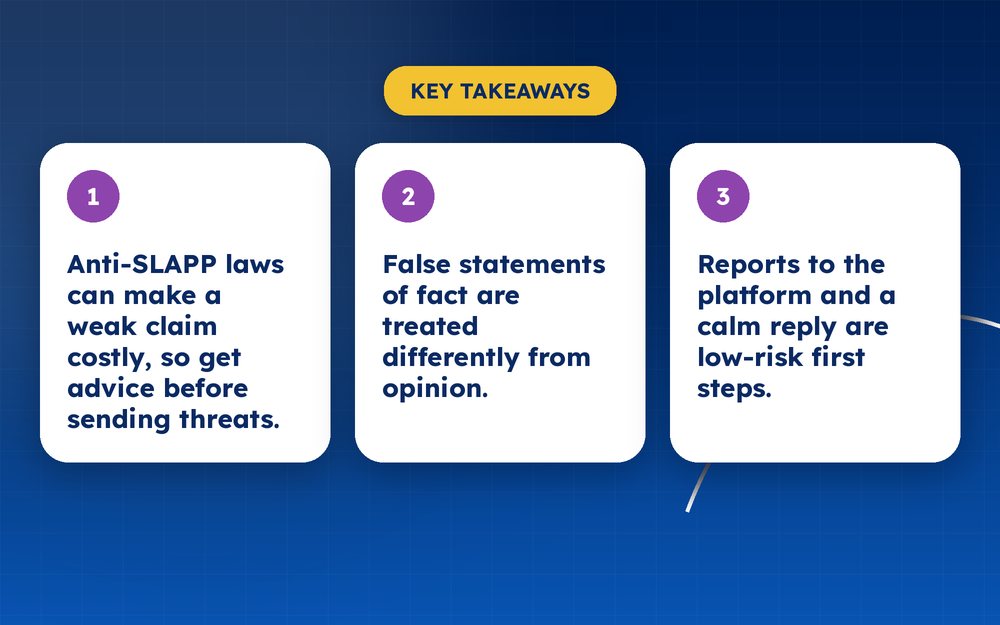
- Anti-SLAPP laws can make a weak claim costly, so get advice before sending threats.
- False statements of fact are treated differently from opinion.
- Reports to the platform and a calm reply are low-risk first steps.
How to think about it, step by step
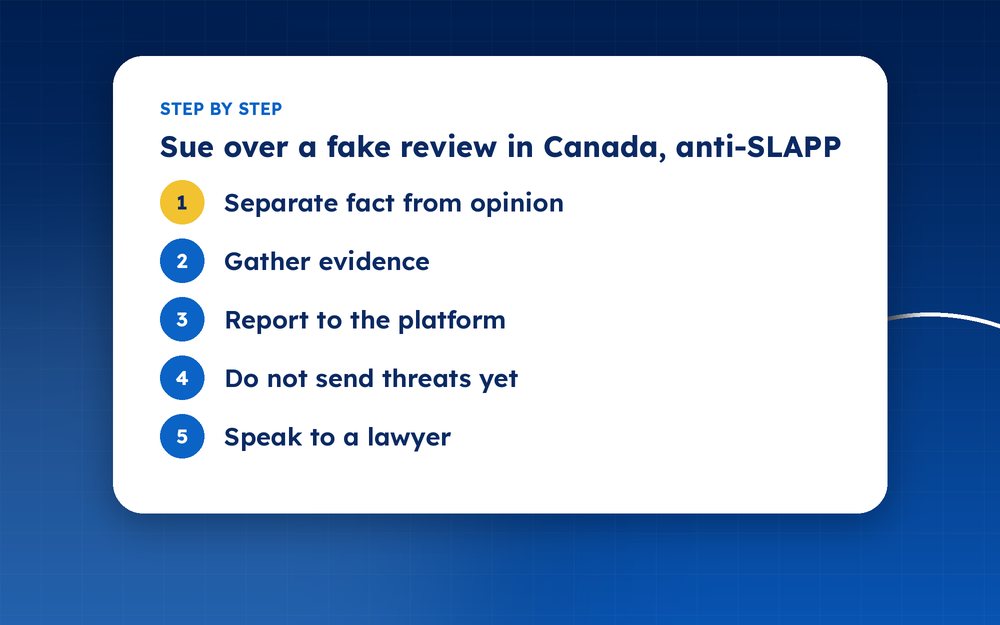
- Separate fact from opinionList which statements are checkable facts and which are views. List the statements in the review and mark which are claims of fact and which are opinions. Only false statements of fact are usually the basis for a claim.
- Gather evidenceSave the review and proof of what is false, such as records. Save the review, dates and documents that show the facts. Record how the review has affected your business.
- Report to the platformIf the review breaks policy, a report is the simplest step. Report the review through the platform's tools. It is quick and may solve the problem without legal risk.
- Do not send threats yetHasty threats can backfire in places with anti-SLAPP rules. Sending an aggressive letter can invite an anti-SLAPP motion. Wait for advice before making legal threats.
- Speak to a lawyerAsk about your province's rules, costs, risks and chances. A lawyer in your province can explain the rules, the risks and the possible costs.
- Consider other routesReplies, genuine reviews and consumer protection reports may do more good. Replies, genuine reviews and consumer protection reports may achieve more than a lawsuit.
- Protect your reputationKeep building genuine reviews and responding well. Keep building trust with customers through accurate information and good service.
What anti-SLAPP means in plain terms
SLAPP stands for strategic lawsuit against public participation. The laws let a defendant ask the court to dismiss a lawsuit early if it targets expression on a matter of public interest, unless the claimant can show the case has substance. If the defendant wins, the claimant may have to pay costs.
Do reviews count as public interest?
Courts have looked at consumer reviews in different ways. A review about the quality of a business may be treated as public-interest expression in some cases. Do not assume your case is safe from a motion to dismiss.
Identifying an anonymous reviewer
If the reviewer is anonymous, you may need a court order to obtain details. This takes time and money, and courts balance privacy and free expression.
A practical approach
Most businesses do better by flagging policy breaches, replying and encouraging genuine reviews. Legal action can be kept for serious, clearly false and damaging statements. If you want to explore it, speak to a lawyer, and you can contact us if you would like a recommendation.
What a typical case looks like
A business owner in Ontario finds a review accusing her of fraud. She saves evidence and reports it to the platform, which does not remove it. She is tempted to send a legal letter, but first speaks to a lawyer, who explains how anti-SLAPP rules could affect her claim and the potential costs. She decides to post a calm reply, gather reviews from real customers and keep the claim as a later option.
Waiting for advice saved her from a costly mistake.
Common mistakes to avoid
Do not send aggressive letters without advice. Do not ignore time limits. Do not post angry replies. And do not offer incentives to remove reviews.
How a specialist can help
A specialist team can prepare policy-based reports and organise evidence that a lawyer may need later. We are not a law firm and cannot give legal advice. Email us in confidence.
Frequently asked questions
Can I sue over a fake review in Canada?
Possibly, but anti-SLAPP laws can make it risky. Ask a lawyer.
What if I lose an anti-SLAPP motion?
You may have to pay the other side's costs.
Will Google reveal the reviewer?
Usually only through a court process.
Is there a cheaper option?
Yes. Platform reports and replies.
How long do I have to act?
Time limits apply. Get advice early.
Is this legal advice?
No. It is general information.
Need help with this?
Every situation is different. Email us the details in confidence and we will reply with an honest assessment of what can be done.
Contact us by email Google review removalThis guide is general information, not legal advice. DMCA Reputation is not a law firm.
Related guides
Can Australian Businesses Sue Over Fake Reviews?
Can Australian businesses sue over fake reviews? A general overview of defamation rules for small businesses, the serious harm test, anonymous reviewers and alternatives.
Read the guide · 3 min
How to Unmask an Anonymous Reviewer Legally
How to unmask an anonymous reviewer legally: what courts consider, John Doe and disclosure orders in general, costs, privacy balance and alternatives. Not legal advice.
Read the guide · 4 min
How to Remove a Google Review: A Complete Guide for Business Owners
How to remove a Google review: what Google will remove, how to report it, how to appeal and what to do if it stays. A guide for business owners.
Read the guide · 6 min