
Businesses often want to know who wrote a damaging review. Platforms will not usually tell you, but there are legal routes in some countries. They are slow, costly and not guaranteed.
This page is general information, not legal advice. Anonymous speech is protected in many places, and courts balance privacy and free expression against the claimant's interest in pursuing a claim.
Different countries use different tools. In the US, claimants may file a lawsuit against a "John Doe" and ask the court to allow a subpoena. In the UK and some other places, courts can order disclosure from a platform. Details and standards differ.
Courts take anonymity seriously and weigh it against your claim. Unmasking is usually a last resort, and works best when the statements are clearly false and clearly damaging.
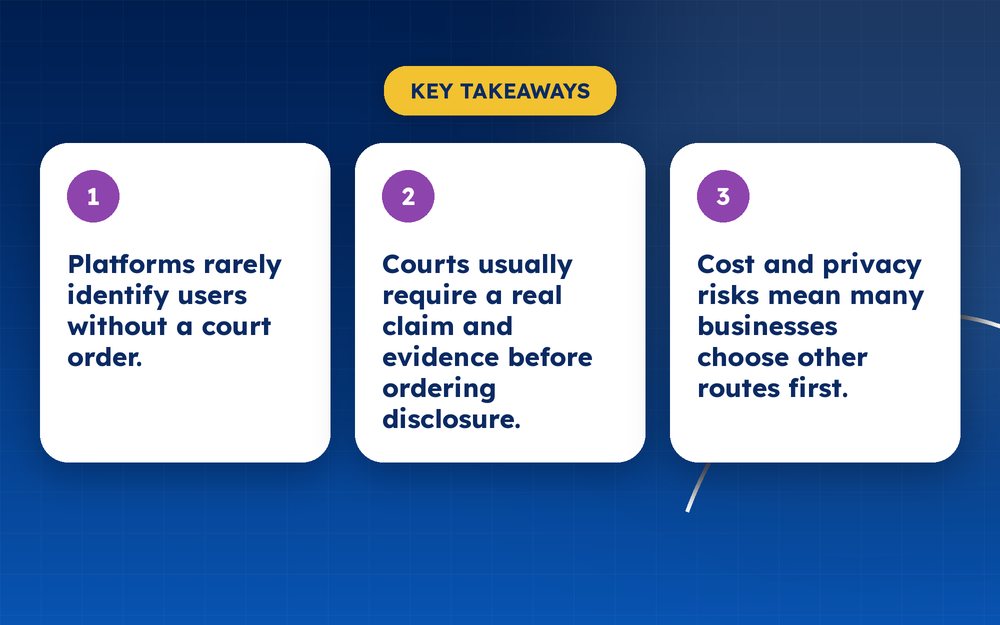
- Platforms rarely identify users without a court order.
- Courts usually require a real claim and evidence before ordering disclosure.
- Cost and privacy risks mean many businesses choose other routes first.
How to think about it, step by step
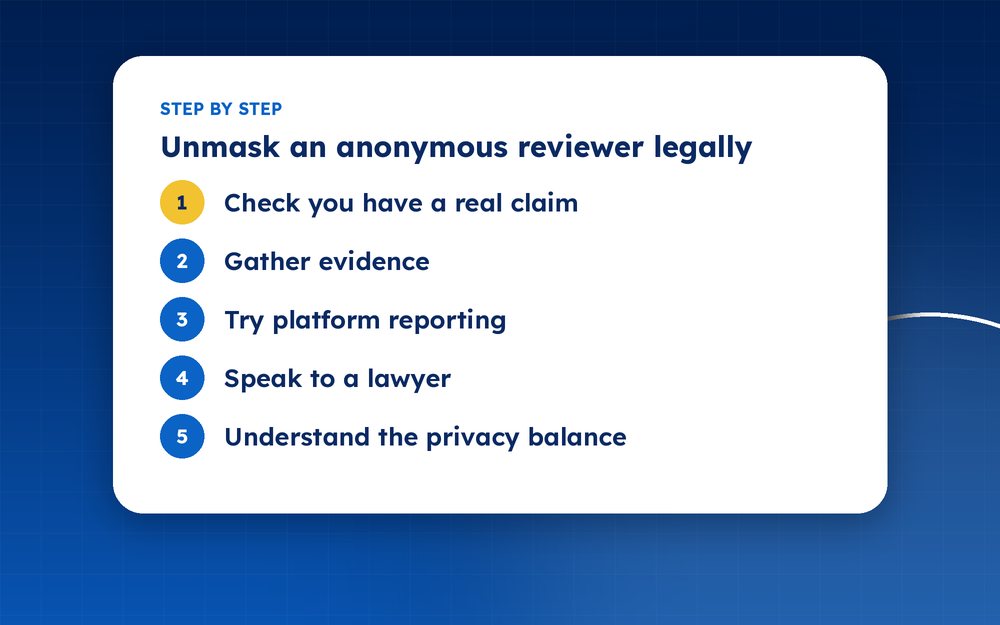
- Check you have a real claimIdentify false statements of fact and the harm they caused. Ask whether the review contains false statements of fact that harm your business, not just criticism.
- Gather evidenceSave the review, dates and records showing falsity. Save the review, evidence of falsity and records of harm. Courts expect a strong case.
- Try platform reportingIf the review breaks policy, it may be removed without any court action. Report the review to the platform, and try a reply. These steps are cheaper and may be enough.
- Speak to a lawyerAsk about disclosure routes in your location, costs and chances. A lawyer can explain the court process, the cost and whether a claim is likely to succeed.
- Understand the privacy balanceCourts consider free expression and the strength of your claim. Courts weigh the claimant's case against the reviewer's privacy and free expression. Weak claims may fail and cost you money.
- Weigh cost and benefitDecide whether the likely outcome justifies the effort. Compare the cost and time with the benefit. Sometimes a platform removal and a reply achieve the same result.
- Keep other options openReplies, genuine reviews and removal reports continue regardless. Even while you consider legal steps, continue with reports and replies.
What courts usually look for
Courts often ask whether the claimant has a real, arguable case, whether the information sought is necessary and whether the reviewer's privacy rights outweigh the claimant's interest. Weak or purely vindictive claims are unlikely to succeed.
What the platform can provide
Platforms may hold limited information, such as an email address or IP logs. This may not identify the person directly, and further steps may be needed. Results vary.
Risks
Starting legal action can attract attention to the review and lead to costs orders if you lose. In some places, anti-SLAPP laws apply. Take advice before starting.
Alternatives
Many businesses decide that flagging policy breaches, replying and building genuine reviews are better value. We can help with the practical side, and you can contact us if you want a recommendation for a lawyer. We do not promote particular law firms in our guides.
What a typical case looks like
A business owner is targeted by an anonymous review accusing him of fraud. Reports fail, so he speaks to a lawyer, who explains the court process and costs. They agree that the statements are clearly false and damaging, so the lawyer applies for an order to identify the reviewer. The court allows it and the reviewer turns out to be a former supplier. The matter ends in a settlement.
Not every case is as clear, and many are better resolved without court.
Common mistakes to avoid
Do not try to identify the reviewer by amateur investigation, which can create legal and safety risks. Do not accuse someone publicly. Do not ignore time limits. And do not rely on rumours.
How a specialist can help
A specialist team can prepare reports and organise evidence, which helps any lawyer you instruct. We are not a law firm and cannot give legal advice. Email us in confidence.
Frequently asked questions
Can I find out who wrote an anonymous review?
Sometimes, through a court order, but courts balance this against privacy and free expression.
Is it expensive?
It can be. Ask a lawyer for an estimate.
Will the platform tell me who it is?
Usually not without a court order.
Are there cheaper options?
Yes. Reports and replies.
Can you recommend a lawyer?
You can contact us for a recommendation if you want to proceed.
Is this legal advice?
No. It is general information, and laws differ by place. For claims or court action, speak to a qualified lawyer.
Need help with this?
Every situation is different. Email us the details in confidence and we will reply with an honest assessment of what can be done.
Contact us by email Google review removalThis guide is general information, not legal advice. DMCA Reputation is not a law firm.
Related guides
What to Do When One Person Posts Multiple Fake Reviews
What to do when one person posts multiple fake reviews: spot the pattern, gather evidence, report to the platform and handle harassment or extortion attempts.
Read the guide · 3 min
How to Get Your Google Business Profile Reinstated After a Suspension
How to get your Google Business Profile reinstated after a suspension: common causes, fixing issues, appeal steps and what to prepare to avoid it happening again.
Read the guide · 3 min
How to Remove a Google Review: A Complete Guide for Business Owners
How to remove a Google review: what Google will remove, how to report it, how to appeal and what to do if it stays. A guide for business owners.
Read the guide · 6 min