
If intimate images of you have been shared without your consent, the first day matters, but it does not have to be perfect. This guide gives you a calm order of steps so you can act without panicking.
Finding out that private images are online is a shock. It is normal to feel sick, angry, ashamed or numb all at once. None of it is your fault. The person who shared the images is responsible for what they did, not you.
The goal for the first 24 hours is simple: keep yourself safe, keep proof, and get the most visible copies reported. You do not need to find every copy today. Quick, organised action on the biggest sites and on search results does more than frantic searching.
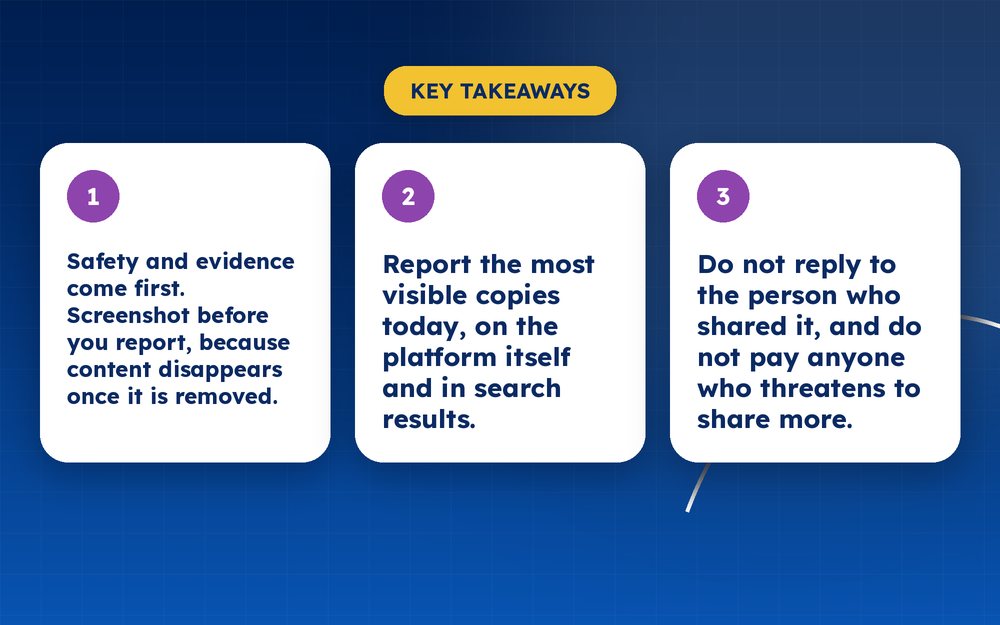
- Safety and evidence come first. Screenshot before you report, because content disappears once it is removed.
- Report the most visible copies today, on the platform itself and in search results.
- Do not reply to the person who shared it, and do not pay anyone who threatens to share more.
If you feel unsafe
If anyone is threatening you or you fear for your safety, contact your local emergency number first. Everything else on this page can wait. If you are overwhelmed, ask a trusted friend to sit with you while you work through the steps. You do not have to do this alone.
Your first 24 hours, step by step
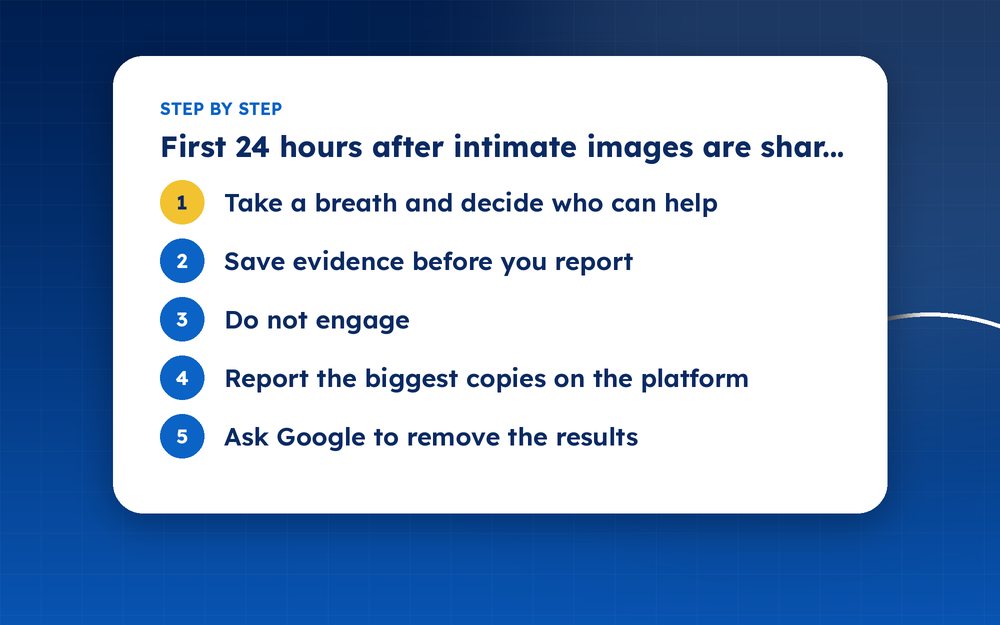
- Take a breath and decide who can helpPick one trusted person who can help you with searching and reporting, so you are not looking at the images repeatedly yourself. A friend, a family member or a professional service can all do this.
- Save evidence before you reportTake screenshots that show the web address, the date, the account name and any messages. Save the links in a note. Do this first, because reported content often vanishes and leaves you with nothing to show.
- Do not engageDo not argue with the person who shared the images, and do not negotiate. Replying gives them attention and can lead to more threats. If they ask for money or more images, do not send anything.
- Report the biggest copies on the platformUse the report option on each post, page or account and choose the category for non-consensual intimate images. Start with the most viewed copies.
- Ask Google to remove the resultsUse Google's request form for non-consensual explicit imagery. It takes the links you give it and works on similar copies too.
- Start hash protection if you are an adultStopNCII.org lets adults create a digital fingerprint of the image on their own device, so participating platforms can block matching uploads. It does not cover every site.
- Secure your accountsChange passwords, turn on two-step login and check which devices are signed in, in case the images came from a hacked account.
- Write down what you didKeep a simple log of each link, when you reported it and what the reply was. It saves time later and helps if you go to the police.
What not to do
Do not forward the images to friends as evidence, even to ask for help. That spreads them further. Do not delete your messages or accounts before saving evidence. Do not pay anyone who says they can make the images disappear if they will not explain exactly how.
A simple plan for the first day
If it helps, split the day into three blocks. In the first hour, focus on safety and on saving evidence. In the next few hours, report the most visible copies and submit your Google request. Later in the day, secure your accounts, write down what you have done and let someone you trust check in on you. Anything left can wait until tomorrow.
It also helps to decide in advance what you will not do. You will not reply to the person who shared the images, you will not agree to pay or to send more, and you will not delete evidence. Making those choices early saves you from making them under pressure.
Who can help you today
Support is available beyond platforms and search engines. Victim support organisations and helplines in many countries can give practical advice and emotional support, often free of charge. The police can take a report and explain what happens next. A trusted friend can help with searching and reporting so you are not repeatedly looking at the images yourself.
If you want specialist help with the removal work itself, a discreet team can handle the searching, the notices and the follow-up. Be careful with any provider that promises guaranteed or instant results, or that asks you to stop contacting the police or to hand over passwords. Honest providers tell you what is realistic.
Why speed helps without making it a race
Leaked content often spreads in waves: it appears in one place, is copied, and is then picked up by search engines. Early reports reduce that spread and give later requests more weight. At the same time, rushing without saving evidence is the most common mistake. A short pause to take screenshots is worth it.
Looking after yourself
Searching for your own images is distressing. Take breaks, eat, sleep and let someone else do the searching where you can. Speaking to a counsellor or a support line is a strength, not a delay. The work can continue over several days.
How a specialist can help
Tracking down copies, preparing notices and following up with platforms takes time and is emotionally draining. A discreet specialist team can take over that work so you can focus on yourself. We cannot promise that every copy will be removed, but we can tell you honestly what is realistic. Email us in confidence to talk it through.
Frequently asked questions
Should I tell the police?
Many people do, and sharing intimate images without consent is a crime in a growing number of countries. A police report is a personal choice, but it can help later with platforms and legal options. Save your evidence first.
Can everything really be removed?
Often a large share can be removed, especially from major platforms and search results, but no honest provider can promise that every copy will disappear. The aim is to remove as much as possible and monitor for new copies.
Should I message the person who shared it?
Usually not. Contact can escalate the situation or lead to more threats. If safety is a concern, speak to the police or a victim support service about the best way to deal with them.
How long will the first reports take to work?
Some platforms act within hours or a few days, others take longer. In the United States, platforms covered by the TAKE IT DOWN Act must act on a valid removal request within 48 hours. Elsewhere, timing varies.
What if I do not know who shared them?
You can still report and remove the content. Keep evidence of where you found it and any accounts involved. Not knowing the person does not stop platforms from acting on a report.
Do I have to look at the images to report them?
You usually need the links, not the images themselves. Where possible ask someone you trust, or a professional service, to handle the searching so you do not have to look.
Need help with this?
Every situation is different. Email us the details in confidence and we will reply with an honest assessment of what can be done.
Contact us by email NCII removalThis guide is general information, not legal advice. DMCA Reputation is not a law firm.
Related guides
What to Do If an Ex Posts Your Intimate Photos Online
What to do if an ex posts your intimate photos online: protect your safety, save evidence, get the images removed and understand your options. A calm, practical guide.
Read the guide · 5 min
How to Report Non-Consensual Intimate Images to Google, Step by Step
How to report non-consensual intimate images to Google: who can ask, what to prepare, how the form works and what happens after you submit. A clear step-by-step guide.
Read the guide · 4 min
How to Remove Non-Consensual Intimate Images (NCII), Step by Step
How to remove non-consensual intimate images (NCII): reporting, StopNCII.org, Google removal, legal options and support. A step-by-step guide.
Read the guide · 4 min