
Many business owners expect Google to remove any unfair review. It does not. Google removes reviews that break its content policies. Knowing the categories helps you decide what to report.
Google's review policies cover areas such as fake engagement, off-topic content, spam, restricted content, illegal content, sexually explicit content, offensive content, dangerous and derogatory content, impersonation, personal information and conflict of interest. The exact wording changes, so read the current policy.
Reviews that are honest accounts of a customer's experience usually stay, even if you disagree with them, because Google wants reviews to reflect real experiences.
Many people expect Google to remove any review that is unfair. In practice, it removes reviews that break its rules, and does not judge whether a review is fair or kind.
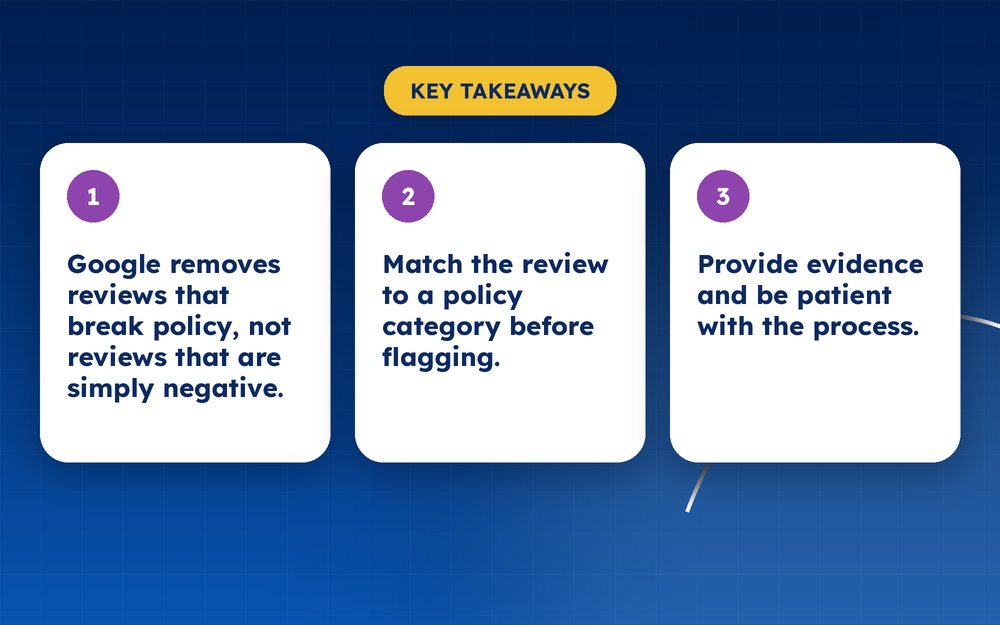
- Google removes reviews that break policy, not reviews that are simply negative.
- Match the review to a policy category before flagging.
- Provide evidence and be patient with the process.
How to use the policy, step by step
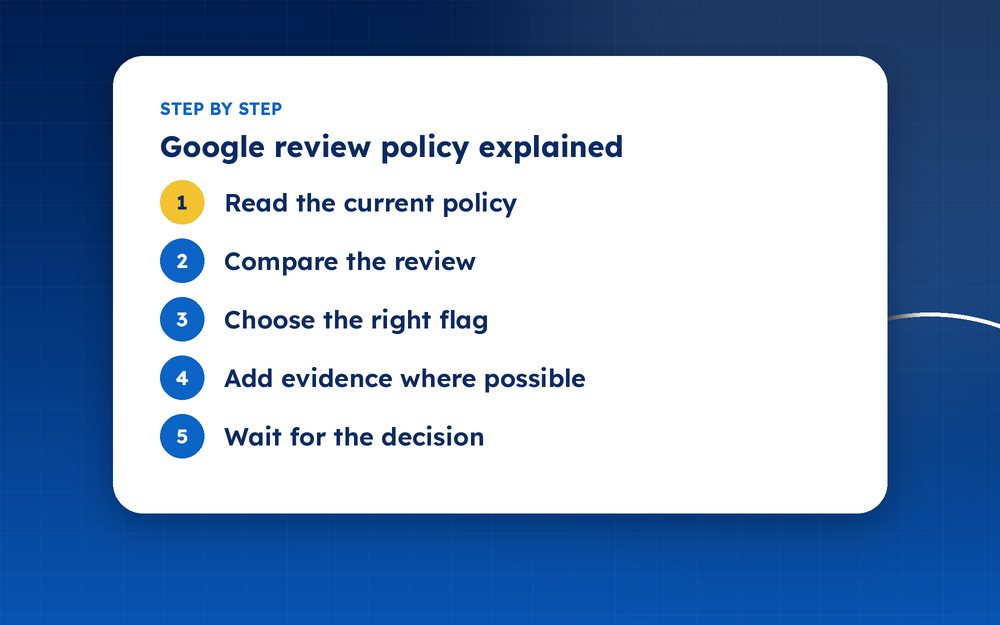
- Read the current policyOpen Google's content policy for reviews and note the categories. Policies change, so read the current version rather than relying on memory or old posts.
- Compare the reviewCheck whether it is fake, off-topic, spam, abusive, contains personal data or is from a conflict of interest. List what the review actually says and match each part to a rule, such as fake engagement, conflict of interest, off-topic, harassment or illegal content.
- Choose the right flagUse the closest reason when flagging. Choose the flag that fits best. A precise reason is better than a vague one.
- Add evidence where possibleProvide details through the appeal or support routes. Add a short explanation and evidence where the tool allows. Keep it factual.
- Wait for the decisionDo not flag repeatedly. Decisions can take days. Avoid repeated flags for the same review.
- Appeal if refusedSubmit extra information if you have it. If refused, you can appeal with more information. Be calm and specific.
- Manage the restReply to genuine reviews and encourage new ones. If the review stays, reply politely and add genuine reviews.
Reviews that tend to be removed
Examples include reviews from people who have never used the business, reviews that contain hate speech, threats or sexual content, reviews posted by staff or competitors, reviews that reveal personal information and spam or promotional content.
Reviews that tend to stay
Honest complaints about price, service, wait times or quality usually stay, even when they seem harsh. Reviews that disagree with your view of what happened also usually stay. Replying politely is the best option.
Legal removal requests
Google also has a process for content that is allegedly illegal, such as defamation, under local law. These requests need more evidence, and Google decides each case. Speak to a lawyer for complicated or serious cases.
Helping your report succeed
A short, clear explanation of the policy breach, with evidence where possible, helps. Avoid long arguments about why the reviewer is wrong.
What a typical case looks like
A shop owner flags a review that says "worst shop ever" but gives no details. Google does not remove it, because it does not break a rule. The owner then flags another review that contains a competitor's promotion, which is removed. She replies to the first review politely and asks customers for genuine reviews.
Knowing what the policy covers saved her time and set realistic expectations.
Common mistakes to avoid
Do not flag reviews just because they are negative. Do not flood Google with repeated flags. Do not retaliate against reviewers. And do not buy reviews.
How a specialist can help
A specialist team can assess which reviews break policy, prepare evidence and follow up with Google. We cannot promise removal, since Google decides, but we will be honest about what is realistic. Email us in confidence.
Frequently asked questions
What reviews does Google remove?
Reviews that break its policies, such as fake engagement, conflicts of interest, off-topic content, harassment and illegal content.
Does Google remove unfair reviews?
Not just because they are unfair. Opinions that follow the rules usually stay.
How do I flag a review?
Use the flag option from your Business Profile and choose the best reason.
Can I appeal?
Yes, with more information.
What if it stays?
Reply politely and collect genuine reviews.
Is this legal advice?
No. It is general information, and laws differ by place. For claims or court action, speak to a qualified lawyer.
Need help with this?
Every situation is different. Email us the details in confidence and we will reply with an honest assessment of what can be done.
Contact us by email Google review removalThis guide is general information, not legal advice. DMCA Reputation is not a law firm.
Related guides
How to Remove a Google Review for a Medical or Cosmetic Clinic
How to remove a Google review for a medical or cosmetic clinic: what Google removes, how to flag reviews, how to respond safely and when to escalate. General information.
Read the guide · 4 min
How to Remove a Review From RealSelf, Healthgrades or Doctify
How to remove a review from RealSelf, Healthgrades or Doctify: platform rules, how to report reviews, how to respond and when removal is realistic. General information.
Read the guide · 4 min
How to Remove a Google Review: A Complete Guide for Business Owners
How to remove a Google review: what Google will remove, how to report it, how to appeal and what to do if it stays. A guide for business owners.
Read the guide · 6 min