
Group-buy and reseller sites sell access to many paid courses and tools at a fraction of the price. Understanding how they run points to the best ways to disrupt them.
These sites usually buy or capture content from creators, then resell it as bundles or subscriptions. Some call it "group buy" and claim a legitimate model, but selling someone else's paid content without permission is infringement.
They depend on hosting, payment services, advertising and search traffic. Reports to each of these, with clear evidence, are the most effective way to shut them down.
Group-buy sites pool money from many buyers to access paid products at a fraction of the price, often without permission. Understanding their structure shows you where to apply pressure.
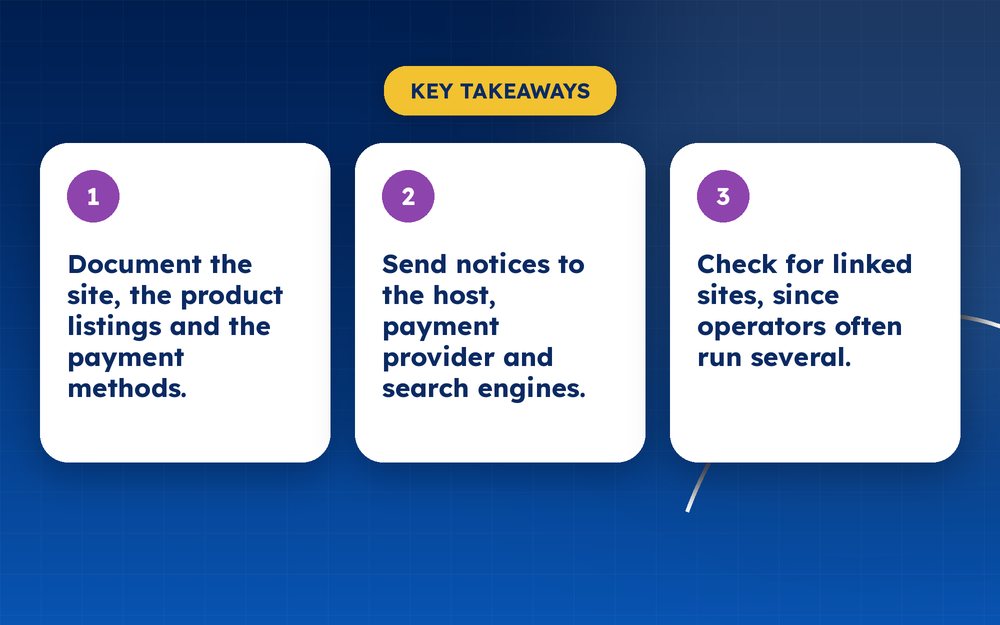
- Document the site, the product listings and the payment methods.
- Send notices to the host, payment provider and search engines.
- Check for linked sites, since operators often run several.
How to shut them down, step by step
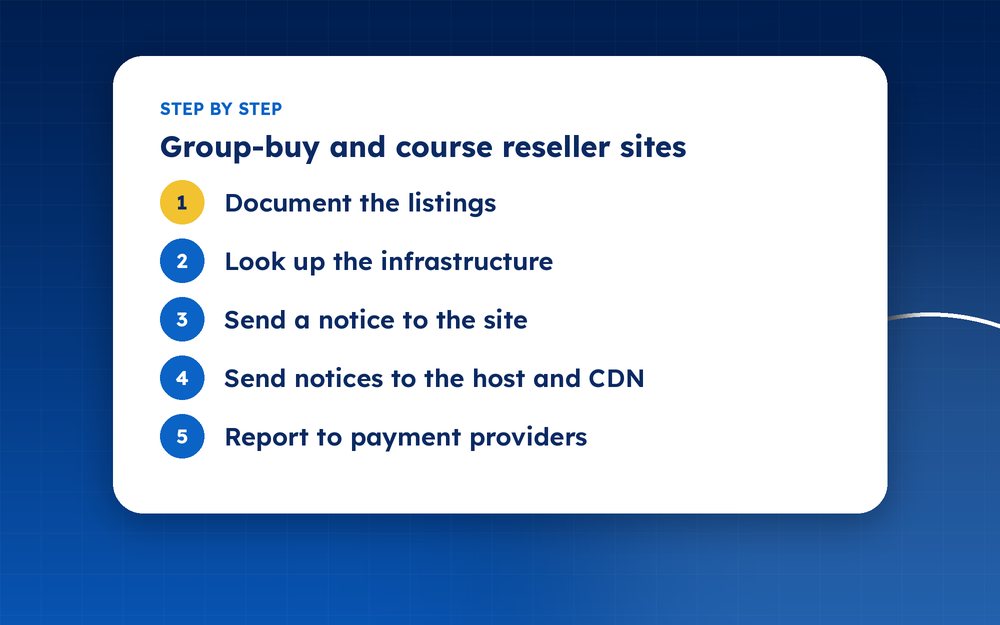
- Document the listingsCapture your course on the site, the price, and the site's pages and terms. Save the listings, prices, terms and checkout. Record the date and the site's contact details.
- Look up the infrastructureFind the host, CDN, registrar and payment providers. Look up the host, delivery network, registrar and payment services. These are your targets.
- Send a notice to the siteCite your rights and list the infringing pages. Send a notice to the site with your proof and the links. Expect many to ignore it.
- Send notices to the host and CDNInclude the same evidence. Send notices to the host and delivery network, citing the infringing listings and the sales.
- Report to payment providersProvide evidence of unauthorised sale. Report the site to payment providers, since selling infringing content breaks their rules.
- Ask search engines to remove linksSubmit copyright requests for each listing. Submit the pages to search engines for removal.
- Look for related sitesSearch for shared branding, contact details or code that link sites, and report them too. Reseller networks often share content. Search for related sites using the same listings or branding.
How the business works
Operators buy one copy of a product, then share it with paying members, or scrape it from other pirates. Subscriptions and bundles bring in revenue. Many hide behind privacy services and change domains when reported.
Why a multi-route approach works
Removing a single page rarely stops them. Hitting hosts, payment and search together raises their costs and cuts visibility. Over time, many operators move on to easier targets.
Working with other creators
Resellers sell many creators' work, so others may be affected too. Sharing evidence with peers, and agreeing a common set of notices, can add weight. Take care to share only what is accurate.
Legal options
For big operations, speak to a lawyer about civil claims and cross-border action. We are not a law firm and cannot give legal advice, but removal can proceed alongside.
What a typical case looks like
A creator finds her course in a group-buy bundle. She records the listings and finds that the site uses a content delivery network and a payment processor. The network suspends the site after her notice, and the payment provider closes the account. She then finds two sister sites with the same catalogue and repeats the process.
Following the infrastructure led her to the related sites.
Common mistakes to avoid
Do not pay for membership to check. Do not engage with operators. Do not rely on one notice. And do not forget to track new domains.
How a specialist can help
A specialist team can document these sites, send notices to every layer and monitor new domains. We cannot promise every site will be shut down, but we will be honest about what is realistic. Email us in confidence.
Frequently asked questions
What is a group-buy site?
A site where people pool money to buy access to paid products, often without the owner's permission.
Are group-buy sites legal?
Selling access to copyrighted content without permission is typically infringement. Local law varies.
How can I shut one down?
Notices to hosts, networks, payment providers and search engines can limit them.
Will they come back?
Often under new domains.
Should I sue?
Court action is costly. A lawyer can advise.
Is this legal advice?
No. It is general information. For claims or court action, speak to a qualified lawyer.
Need help with this?
Every situation is different. Email us the details in confidence and we will reply with an honest assessment of what can be done.
Contact us by email Piracy monitoringThis guide is general information, not legal advice. DMCA Reputation is not a law firm.
Related guides
How to Remove Your Pirated Online Course From Telegram and Torrent Sites
How to remove your pirated online course from Telegram and torrent sites: find the copies, send DMCA notices, report channels and cut off search traffic.
Read the guide · 4 min
How to Find Out Where Your Online Course Has Been Leaked
How to find out where your online course has been leaked: search methods, monitoring tools, where leaks appear and how to record what you find for takedowns.
Read the guide · 4 min
How to Send a DMCA Takedown Notice (With Template)
How to send a DMCA takedown notice: what to include, who to send it to, a free template, counter-notices and common mistakes.
Read the guide · 5 min