
A site with no contact page is not out of reach. Websites depend on hosts, registrars and other providers, and these have contacts and policies.
Anonymous sites often hide behind privacy services and offshore hosts. Even so, they need servers, domain registration and sometimes content delivery networks, all of which have abuse contacts.
The process is to identify the providers, send a clear notice and use search removal to cut traffic while you wait.
A site with no contact page is not invisible. Every website has a host, a domain registrar and often a content delivery network, and each of them has an abuse contact. These are your real routes.
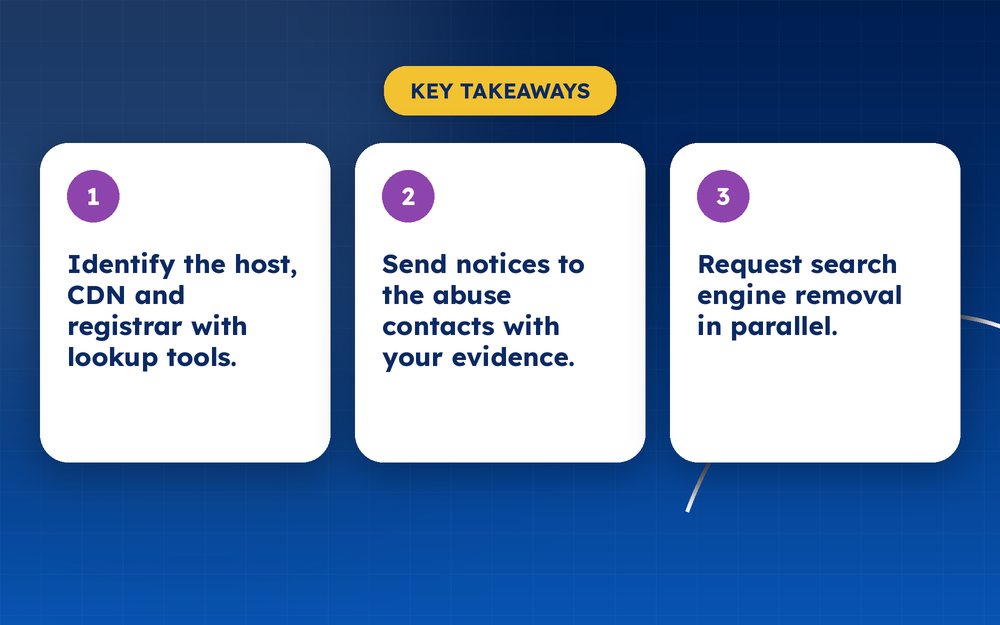
- Identify the host, CDN and registrar with lookup tools.
- Send notices to the abuse contacts with your evidence.
- Request search engine removal in parallel.
How to remove it, step by step
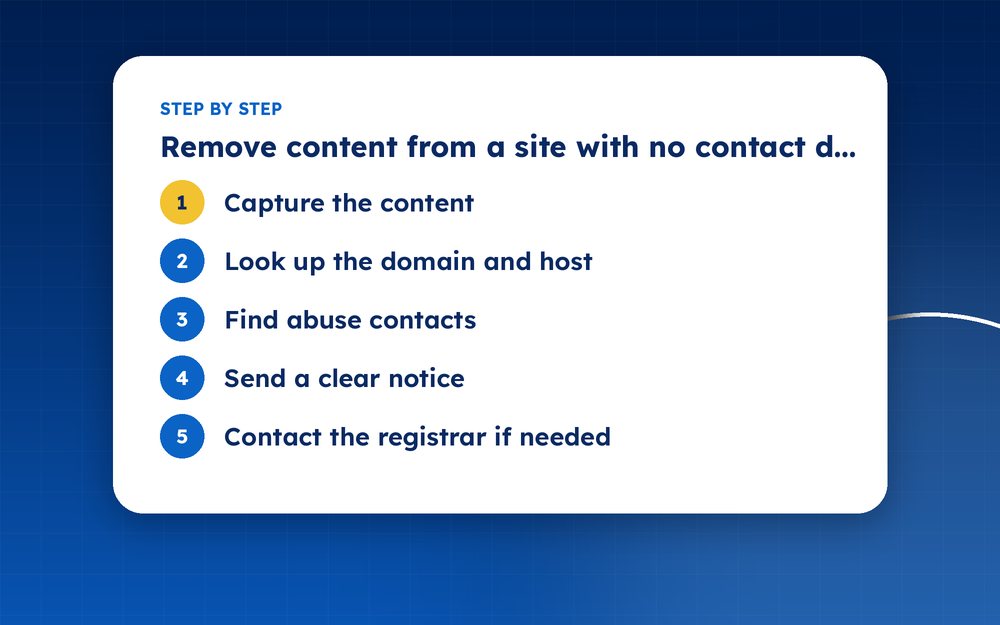
- Capture the contentTake screenshots and save the page addresses with dates. Take full screenshots and save the page address, date and time. Save the page source where you can.
- Look up the domain and hostUse domain and IP lookup tools to find the hosting company and CDN. Use a public lookup tool to find the domain registration and hosting company. Note the names and any abuse contact addresses.
- Find abuse contactsCheck the provider's website for abuse or copyright forms. Look for an abuse or legal contact for the host, the registrar and any content delivery network. Many publish them on their websites.
- Send a clear noticeDescribe the problem, the links and the legal or policy basis. Write a short, complete notice with exact links, the reason for removal and proof of rights. State what you ask them to do.
- Contact the registrar if neededRegistrars may act on clear abuse. If the host does not respond, notify the registrar, who may act under domain rules, especially for fraud or copyright.
- Ask search engines to remove linksUse their forms where the content qualifies. Submit the links to search engines under their copyright or personal information processes, so traffic drops while you wait.
- Follow up and escalateKeep records and escalate to the next provider. Follow up after a few days with a short reminder, and escalate to other providers if needed.
What privacy services hide
Privacy services hide owner details in public records but do not hide the host or registrar. Providers can often forward complaints to their customers or act themselves.
Choosing the right basis
Use copyright for content you own, abuse or harassment for harmful content and legal routes for defamation. Match the provider's policies for the best chance.
Offshore hosts
Some hosts ignore notices. In that case, use CDNs, registrars, payment providers and search engines. Even partial results can reduce harm.
Safety and privacy
Be careful about what personal information you send in notices, since providers may forward complaints to the site owner. Share only what is needed.
What a typical case looks like
A person finds private photos on a small site with no contact form. She looks up the host and registrar, finds abuse addresses and sends a notice to each. The host suspends the page after four days. She also asks the search engine to remove the links, which takes effect within a week.
The site owner was never contacted, but the infrastructure providers solved it.
Common mistakes to avoid
Do not send threats. Do not share unnecessary personal data. Do not skip evidence. And do not stop at one provider.
How a specialist can help
A specialist team can trace infrastructure, send notices and escalate, while keeping your details confidential where possible. We cannot promise results, but we will be honest about what is realistic. Email us in confidence.
Frequently asked questions
How do I find who hosts a website?
Use public domain and hosting lookup tools. They show the registrar, nameservers and often the host. Abuse contacts are usually published by those companies.
Do hosts really act on notices?
Many do, especially for clear copyright, privacy or illegal content. Some ignore them, which is why escalation matters.
What if the owner hides behind privacy protection?
The host and registrar remain reachable, and they can act without identifying the owner.
Can search engines help?
Yes. They can remove results that show infringing or private content, which reduces visibility.
How long does it take?
From a few days to a few weeks, depending on the providers.
Is this legal advice?
No. It is general information. For claims or disputes, speak to a qualified lawyer.
Need help with this?
Every situation is different. Email us the details in confidence and we will reply with an honest assessment of what can be done.
Contact us by email Negative content removalThis guide is general information, not legal advice. DMCA Reputation is not a law firm.
Related guides
How to Remove a Quora or Medium Post About You
How to remove a Quora or Medium post about you: use the platform's report tools, contact the author, address policy and legal grounds and manage search visibility.
Read the guide · 4 min
How to Remove a Pinterest Pin That Infringes Your Content
How to remove a Pinterest pin that infringes your content: copyright notices, reporting tools, what to include, tracking and handling repeat pins.
Read the guide · 4 min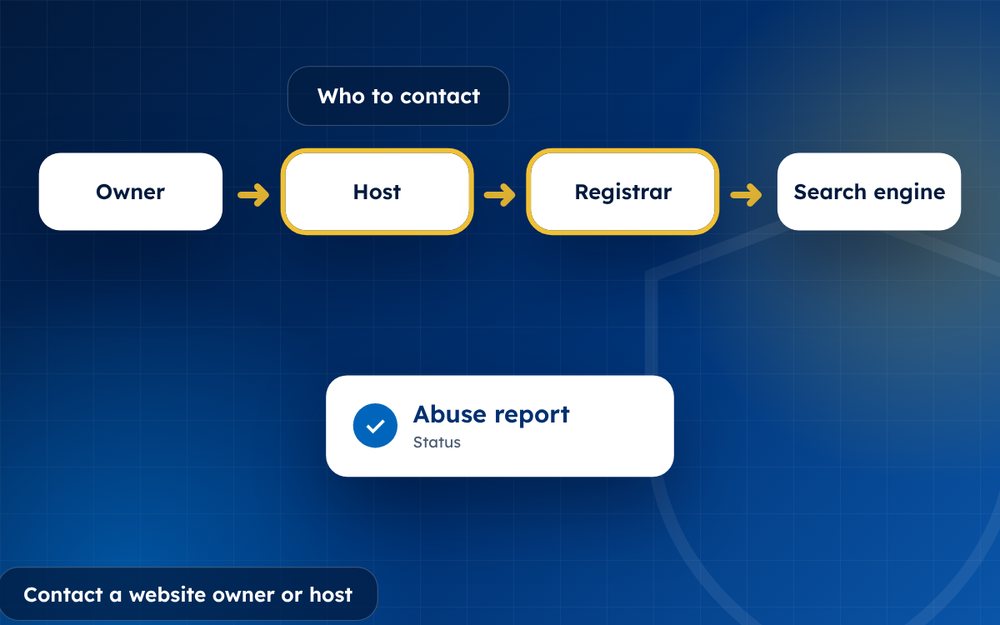
How to Contact a Website Owner or Hosting Company to Remove Content
How to contact a website owner or hosting company to remove content: finding contacts, writing the request and escalating step by step.
Read the guide · 4 min