
A single person using several accounts to post fake reviews can distort your rating. The pattern itself is evidence, and platforms often act faster when you show it clearly.
Multiple fake reviews from one person can come from a former employee, a competitor or someone with a grudge. They may use different names and accounts, but patterns often give them away: similar wording, timing, topics and links between accounts.
Your goal is to show those patterns clearly, report them under the relevant policy and avoid actions that make things worse.
Multiple reviews from one person, or a group, are easier to prove than a single review because the pattern tells a story. Your job is to show it clearly.
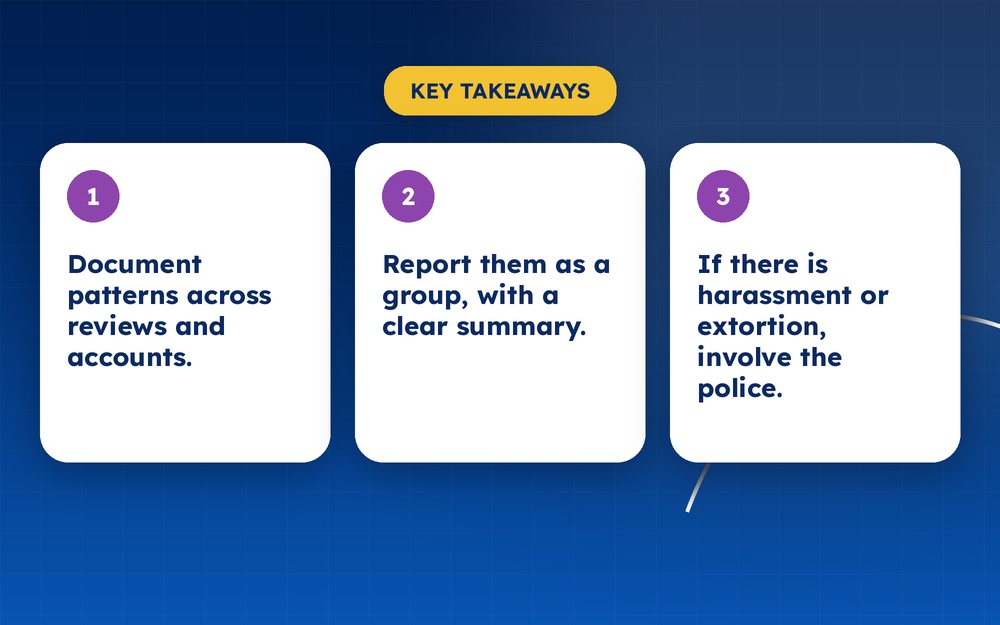
- Document patterns across reviews and accounts.
- Report them as a group, with a clear summary.
- If there is harassment or extortion, involve the police.
What to do, step by step
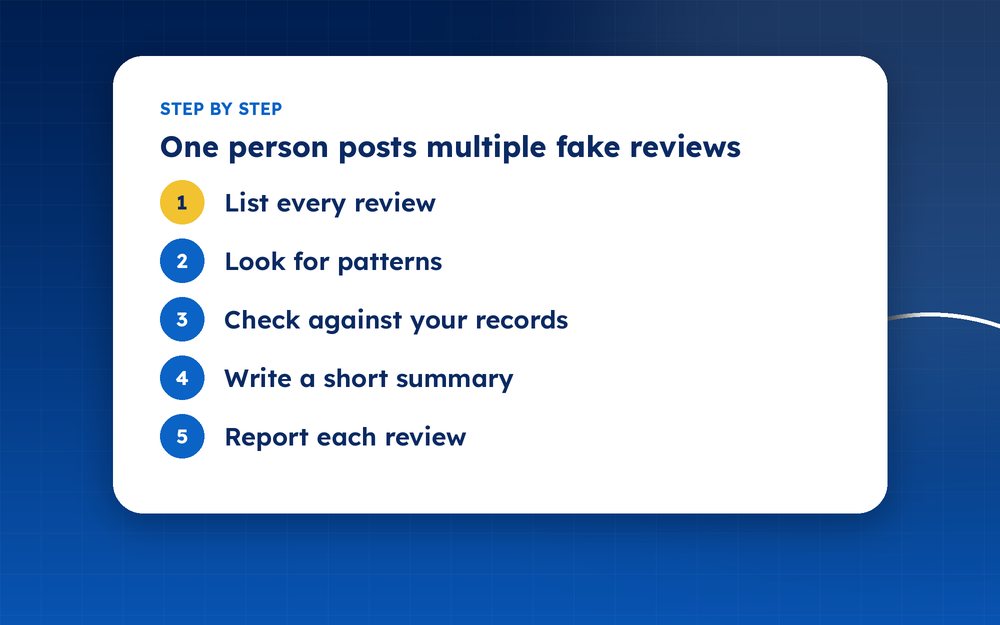
- List every reviewRecord the text, date, account name and link for each. Capture every review with the account name, date and link. Put them in a table.
- Look for patternsCompare wording, timing, reviewer profiles and shared details. Look for shared wording, similar profile photos, timing and reviews of the same business places.
- Check against your recordsSee whether the reviewers match any customers or staff. Compare each review with bookings, orders and messages. Mark those that match no customer.
- Write a short summaryExplain why you believe the reviews come from one person, factually. Write a one-page summary of the pattern, with dates and examples. Keep it factual.
- Report each reviewUse the relevant policy and attach your summary. Report each review individually and mention the pattern and your summary.
- Reply to a fewRespond politely to the visible ones, without accusing anyone. Reply to a few of the most visible reviews, politely and briefly, to show you take them seriously.
- Watch for escalationIf threats or demands appear, save them and consider the police. Watch for new accounts and keep reporting. Persistent attackers may return.
Patterns that help your report
Look for the same phrases, the same spelling mistakes, bursts of reviews within hours, reviews of other businesses that you also know are related and details only a former employee would know. Keep the description factual and avoid naming individuals publicly.
If you suspect a former employee or competitor
Do not confront them publicly. Gather evidence and report to the platform. If there is breach of confidence or harassment, a lawyer can advise on legal steps. We are not a law firm and cannot give legal advice.
Protecting your rating meanwhile
Encourage genuine customers to review, which dilutes the effect. Keep your profile updated and respond to genuine complaints promptly.
If someone demands money
Do not pay. Save the messages, report to the platform and consider the police. Paying often leads to more demands.
What a typical case looks like
A salon sees seven negative reviews from different names in a day, all using the same phrases. The owner makes a table, shows that none match any client and writes a short summary. She reports each review and attaches the summary. Google removes six within ten days. She replies to the remaining one and asks real clients for reviews.
The summary made it easy for the reviewer to see the pattern.
Common mistakes to avoid
Do not accuse people publicly. Do not post fake reviews in return. Do not reply angrily. And do not delay reporting.
How a specialist can help
A specialist team can analyse review patterns, prepare reports and follow up. We cannot promise removal, but we will be honest about what is realistic. Email us in confidence.
Frequently asked questions
Can I report many reviews at once?
You report each review, but you can mention the pattern and attach a summary.
How do I prove they are linked?
Show similar wording, timing and profiles, and that none match customers.
Will the platform ban the person?
It may, if it sees a pattern of abuse.
What if more reviews appear?
Keep reporting and keep a log.
Should I reply to all of them?
Reply to a few visible ones, briefly.
Is this legal advice?
No. It is general information, and laws differ by place. For claims or court action, speak to a qualified lawyer.
Need help with this?
Every situation is different. Email us the details in confidence and we will reply with an honest assessment of what can be done.
Contact us by email Google review removalThis guide is general information, not legal advice. DMCA Reputation is not a law firm.
Related guides
How to Get Your Google Business Profile Reinstated After a Suspension
How to get your Google Business Profile reinstated after a suspension: common causes, fixing issues, appeal steps and what to prepare to avoid it happening again.
Read the guide · 3 min
How to Respond to a Patient Review Without Breaking Confidentiality
How to respond to a patient review without breaking confidentiality: safe wording, what to avoid, examples of structure and when to take the conversation offline.
Read the guide · 3 min
How to Remove a Google Review: A Complete Guide for Business Owners
How to remove a Google review: what Google will remove, how to report it, how to appeal and what to do if it stays. A guide for business owners.
Read the guide · 6 min