
Laws against sharing intimate images without consent now exist in many countries, but they differ in wording, penalties and how victims can use them. This overview explains the general picture.
This page is general information, not legal advice. Laws change, and details matter, so check current rules or speak to a qualified lawyer in your country. The aim here is to give a broad picture so you know what questions to ask.
Across jurisdictions, the common idea is the same: sharing intimate images without consent can be a crime, and platforms and regulators increasingly have duties to act. For removal, the practical routes often matter more than the legal detail.
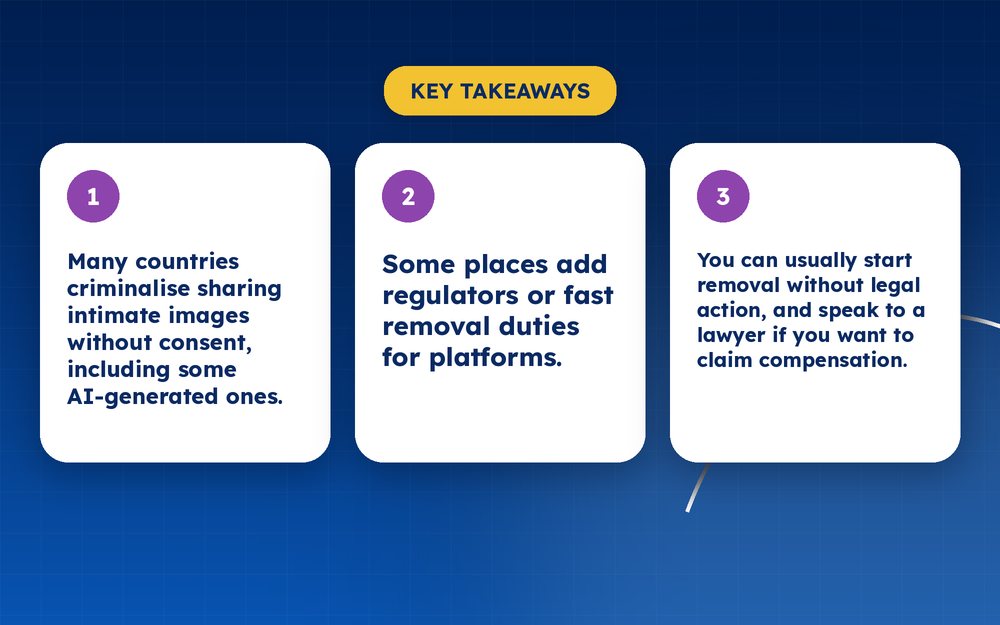
- Many countries criminalise sharing intimate images without consent, including some AI-generated ones.
- Some places add regulators or fast removal duties for platforms.
- You can usually start removal without legal action, and speak to a lawyer if you want to claim compensation.
How to use this information, step by step
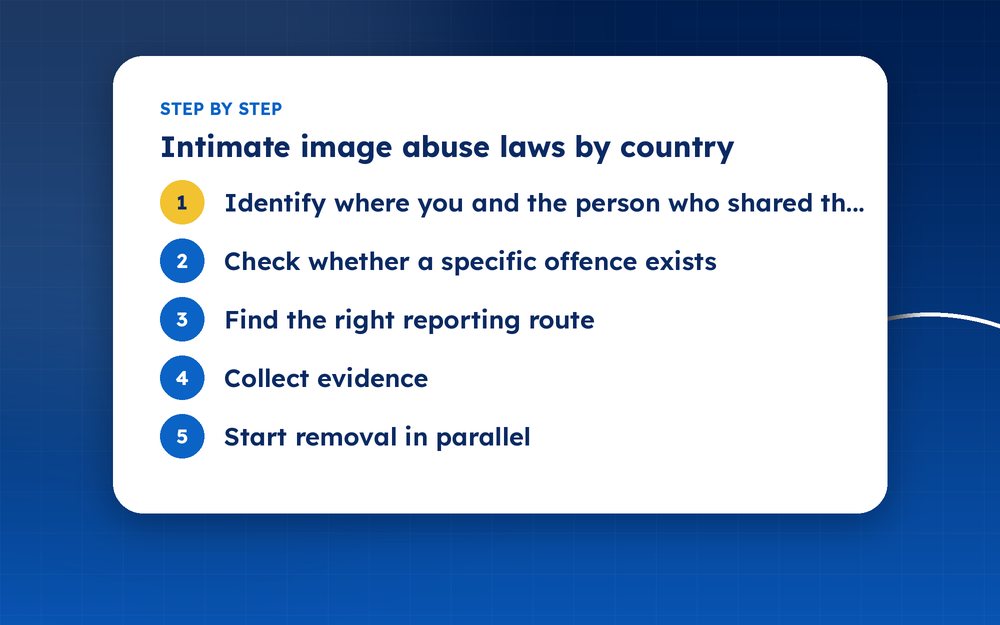
- Identify where you and the person who shared the content liveDifferent countries may apply. Note both, and where the content is hosted. Write down where you live, where the person lives and where the platform is based. This affects which laws apply.
- Check whether a specific offence existsSearch for the law on sharing intimate images without consent in your country, or ask a local support service. Look for a specific offence for sharing intimate images without consent, and for related offences such as harassment, threats or voyeurism.
- Find the right reporting routeThis may be the police, a regulator or a specialist helpline. Many places have reporting routes, such as a police unit, a regulator or a hotline. Check official sites.
- Collect evidenceSave links, screenshots, messages and dates, which support any route. Save links, screenshots, messages and dates. Evidence supports any route.
- Start removal in parallelPlatform reports and search engine requests do not have to wait for legal steps. You do not need to wait for a legal process. Platform and search engine reports can start now.
- Speak to a lawyer if you want to claimA lawyer can explain criminal and civil options in your location. If you want compensation or a court order, a lawyer in the relevant country can advise.
United States
Most US states have laws against sharing intimate images without consent, and federal law now also addresses the issue. The TAKE IT DOWN Act requires covered platforms to remove reported non-consensual intimate images within 48 hours of a valid request, with FTC enforcement. State laws vary in scope and penalties.
United Kingdom
Sharing intimate images without consent is a criminal offence in the UK, and the offences have been widened in recent years, including to cover some forms of altered or synthetic images. Regulators have also been given powers over online safety. Details differ between England and Wales, Scotland and Northern Ireland.
European Union
EU member states have their own criminal laws, and EU-level rules on violence against women and on online platforms add duties and standards. The details depend on the country, so local advice is important.
Canada, Australia and Singapore
Canada has a criminal offence for publishing intimate images without consent. Australia has a federal eSafety Commissioner who can order removal of intimate images and has powers over platforms, as well as state criminal laws. Singapore has criminal law on the issue and has also moved to add a dedicated online safety body and faster takedown powers. Check the current position in each place.
What a typical case looks like
A woman in one country learns that an ex-partner in another has posted her images. She starts removal on the platforms and search engines right away, and reports to the police where she lives. She learns that her country has a specific offence and that the other has a more general one. A lawyer explains what is realistic across borders.
Starting with removal gave her relief while the legal questions were worked out.
What this means for removal
Legal rules support removal, but they are not a precondition for it. Most platforms and search engines act on non-consensual intimate content under their own policies. If you want to claim compensation or see a prosecution, speak to the police or a lawyer, and you may contact us if you want a recommendation.
How a specialist can help
Whatever the law in your country, removal is a practical task of finding, reporting and monitoring. A specialist team can take that on while you decide on any police or legal steps. We are not a law firm and cannot give legal advice. Email us in confidence.
Frequently asked questions
Is sharing intimate images without consent illegal everywhere?
Not everywhere, but in a growing number of countries. The scope and penalties differ.
Do these laws cover deepfakes?
Some do, and more are being updated. Check current rules for your country.
Can I get content removed even if the law is unclear?
Yes. Platform and search engine policies often apply regardless of the law.
Which country's law applies if the poster is abroad?
It can be complicated. A lawyer can advise, but removal can proceed in the meantime.
Do I need to report to the police first?
No. You can start removal at once, and report to the police if you choose.
Is this legal advice?
No. It is a general overview and may be out of date.
Need help with this?
Every situation is different. Email us the details in confidence and we will reply with an honest assessment of what can be done.
Contact us by email NCII removalThis guide is general information, not legal advice. DMCA Reputation is not a law firm.
Related guides
How to Report Intimate Image Abuse to the Police and What Evidence to Bring
How to report intimate image abuse to the police: what to say, what evidence to bring, how to protect yourself and how reporting fits with removal. A calm, practical guide.
Read the guide · 4 min
Can You Sue Someone for Sharing Your Intimate Images?
Can you sue someone for sharing your intimate images? A plain overview of civil and criminal options, what removal can do without court, and when to speak to a lawyer.
Read the guide · 4 min
How to Remove Non-Consensual Intimate Images (NCII), Step by Step
How to remove non-consensual intimate images (NCII): reporting, StopNCII.org, Google removal, legal options and support. A step-by-step guide.
Read the guide · 4 min