
A cease and desist letter asks someone to stop using your content. It can work well when you know who is responsible, but it has risks, so think before you send it.
This page is general information, not legal advice. A cease and desist letter is not a court order. It is a formal request, sometimes stating that you may take further action if the person does not comply.
For many cases, a DMCA notice to the host is faster and less confrontational. A letter makes sense when the infringer is identifiable and you want direct compliance or a resolution.
A cease and desist letter is a request, not a court order. It works best when it is calm, specific and backed by evidence, and it can fail if it is aggressive, vague or wrong about your rights.
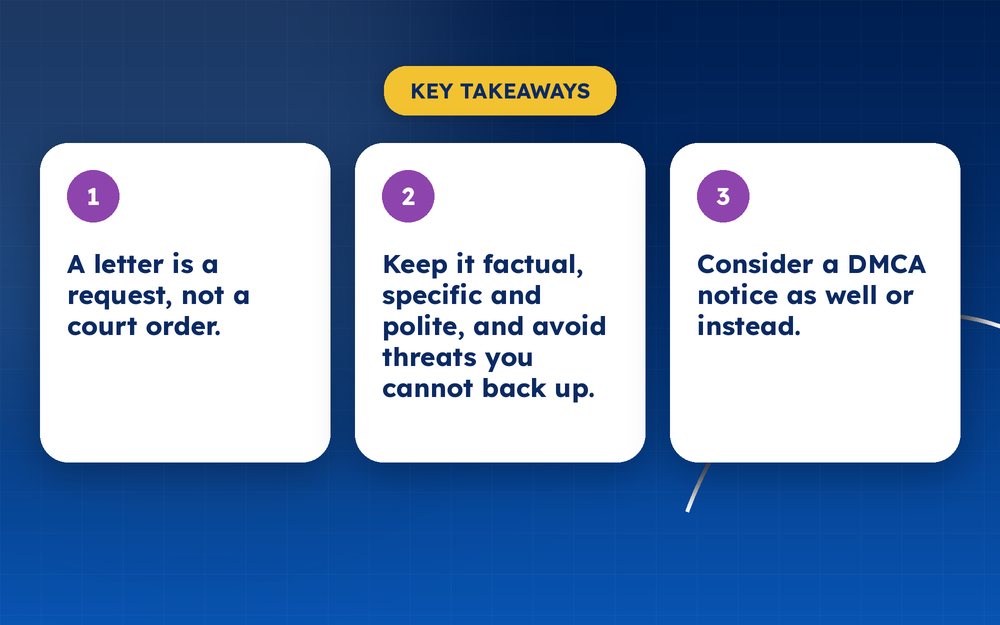
- A letter is a request, not a court order.
- Keep it factual, specific and polite, and avoid threats you cannot back up.
- Consider a DMCA notice as well or instead.
How to send one, step by step
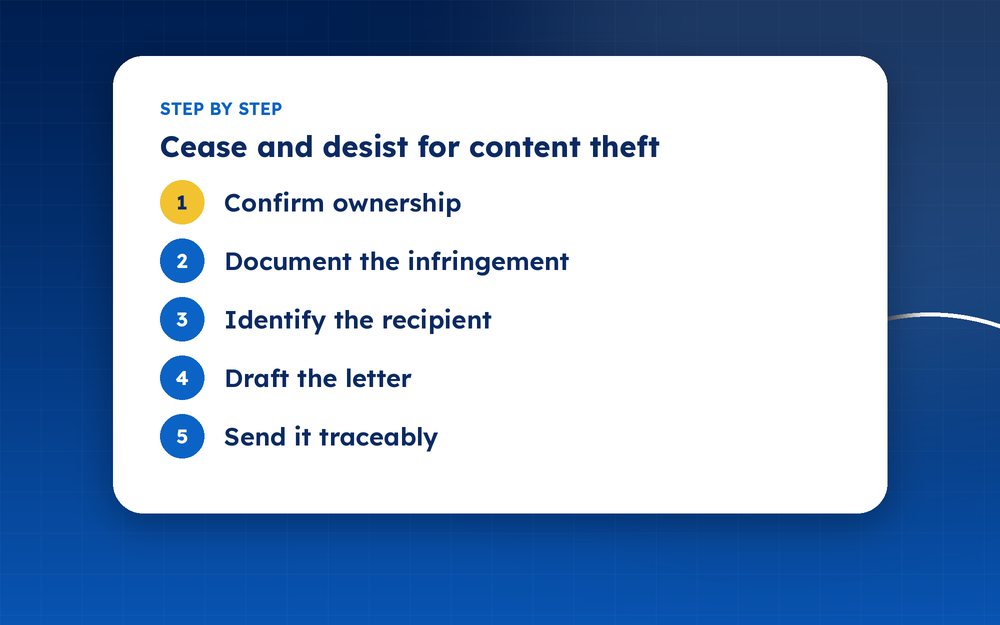
- Confirm ownershipGather proof that you own the content. Gather proof that you created the work, such as original files, dates and publication links. Be sure the work is yours.
- Document the infringementSave links, screenshots and dates. Save screenshots, links and dates of the infringing use. Record where and how it appears.
- Identify the recipientFind the person or business responsible. Find out who is responsible, such as the site owner or seller, using contact pages and lookup tools. Consider also notifying the host.
- Draft the letterDescribe your work, the infringement, what you want them to do and a deadline. Describe your work, the infringement, what you want them to do and a reasonable deadline. Keep it short and factual.
- Send it traceablyUse email and a method that records delivery. Use email or post with proof of delivery. Keep copies.
- Follow upIf there is no response, consider notices to hosts and legal advice. If there is no reply by the deadline, send a short reminder and move to notices to the host and search engines.
- Keep recordsSave the letter and any replies. Keep a file of letters, replies and dates. It will matter if the dispute escalates.
A simple template
Heading: Notice of infringement and request to cease use.
Body: I am the owner of [describe work, with link]. I have found that you are using it without permission at [links]. Please remove it and confirm in writing by [date]. If it is not removed, I may take further steps to protect my rights. My contact details are [email]. [Name].
Keep the tone factual, and adapt it to your case.
Risks
Letters can be published, and a poorly judged letter can attract attention or cause a dispute. If your claim is weak or the recipient has rights you are unaware of, you could create problems. For important matters, ask a lawyer to review.
When a DMCA notice is better
If the content is on a platform or hosted site, a notice to the host often removes it quickly without engaging the infringer. Use it alongside or instead of a letter.
What happens if they refuse
You can send notices to hosts and search engines, consider a formal legal letter from a lawyer and decide whether to take legal action. If you want to take that step, speak to a lawyer, and you can contact us for a recommendation.
What a typical case looks like
A designer finds a competitor using her product photos. She collects originals and screenshots, emails the owner a short letter with links and a seven-day deadline, and asks for removal and confirmation. The competitor replies apologetically and removes the images within three days. Had they not, she would have sent notices to the host and search engine.
A short, factual letter gave them an easy way to comply.
What a basic letter covers
Include your name, a description of your work, the links where it appears, a statement that you did not authorise the use, what you ask them to do, a deadline and your contact details. Avoid threats you cannot or will not carry out, and have a lawyer review for serious matters.
Common mistakes to avoid
Do not make threats you cannot back up. Do not send without evidence. Do not copy third parties. And do not forget deadlines.
How a specialist can help
A specialist team can prepare notices, find hosts and handle follow-up, which often resolves the issue without a letter. We are not a law firm and cannot give legal advice. Email us in confidence.
Frequently asked questions
Is a cease and desist letter legally binding?
No. It is a formal request. Ignoring it may lead to further steps, but it is not itself a court order.
Should I use a template?
A template can help, but adapt it to your facts and avoid claims you cannot support.
Should I send notices at the same time?
Often notices to the host and search engines are more effective, and can be sent in parallel.
What if they ignore it?
Send a reminder, then use notices and consider legal advice.
Can a letter backfire?
Yes, if it is aggressive, wrong or leaked. Keep it measured.
Is this legal advice?
No. It is general information, and laws differ by country. For advice on your situation, speak to a qualified lawyer.
Need help with this?
Every situation is different. Email us the details in confidence and we will reply with an honest assessment of what can be done.
Contact us by email DMCA takedown serviceThis guide is general information, not legal advice. DMCA Reputation is not a law firm.
Related guides
How to File a DMCA Counter-Notice and When to Respond to One
How to file a DMCA counter-notice and when to respond to one: what it says, the timeline, risks, what happens next and why you should consider legal advice first.
Read the guide · 4 min
DMCA Safe Harbor Explained for Content Owners
DMCA safe harbor explained for content owners: why hosts respond to notices, what conditions apply, repeat infringers and how to write notices that work.
Read the guide · 4 min
How to Send a DMCA Takedown Notice (With Template)
How to send a DMCA takedown notice: what to include, who to send it to, a free template, counter-notices and common mistakes.
Read the guide · 5 min