
In the United States, the TAKE IT DOWN Act gives people a legal route to ask platforms to remove non-consensual intimate images within 48 hours. Here is what a valid request needs and how to write one.
The TAKE IT DOWN Act requires covered online platforms to set up a process for removal requests. Platforms were required to comply from May 19, 2026, and must remove a reported image and known identical copies within 48 hours of a valid request. The Federal Trade Commission enforces the law.
The Act focuses on platforms that serve the United States, and it is a US law. Elsewhere, other rules and platform policies apply. This guide is general information, not legal advice, and you should check the current rules for your situation.
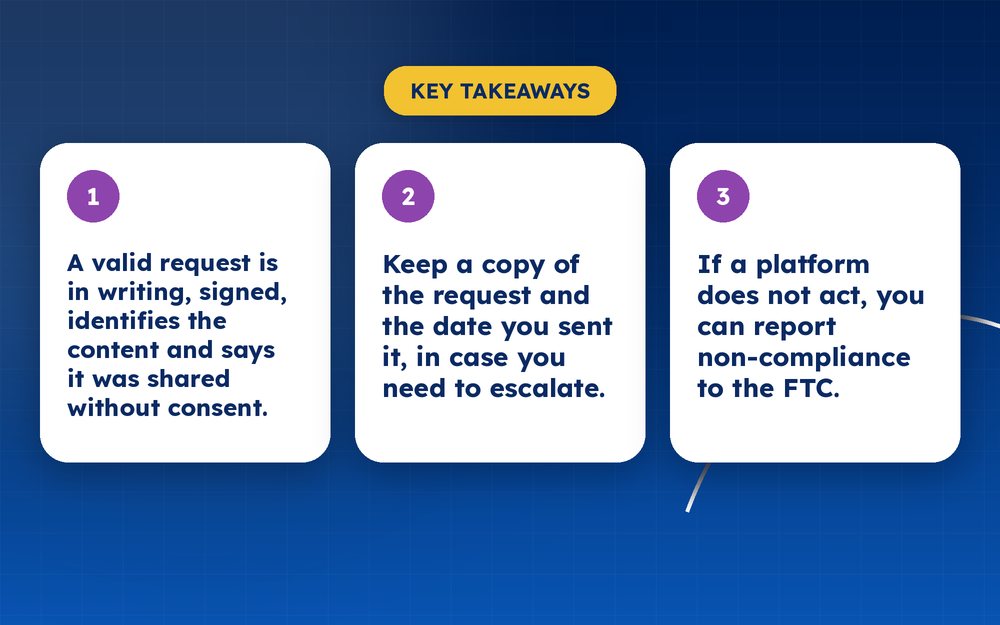
- A valid request is in writing, signed, identifies the content and says it was shared without consent.
- Keep a copy of the request and the date you sent it, in case you need to escalate.
- If a platform does not act, you can report non-compliance to the FTC.
How to make a request, step by step
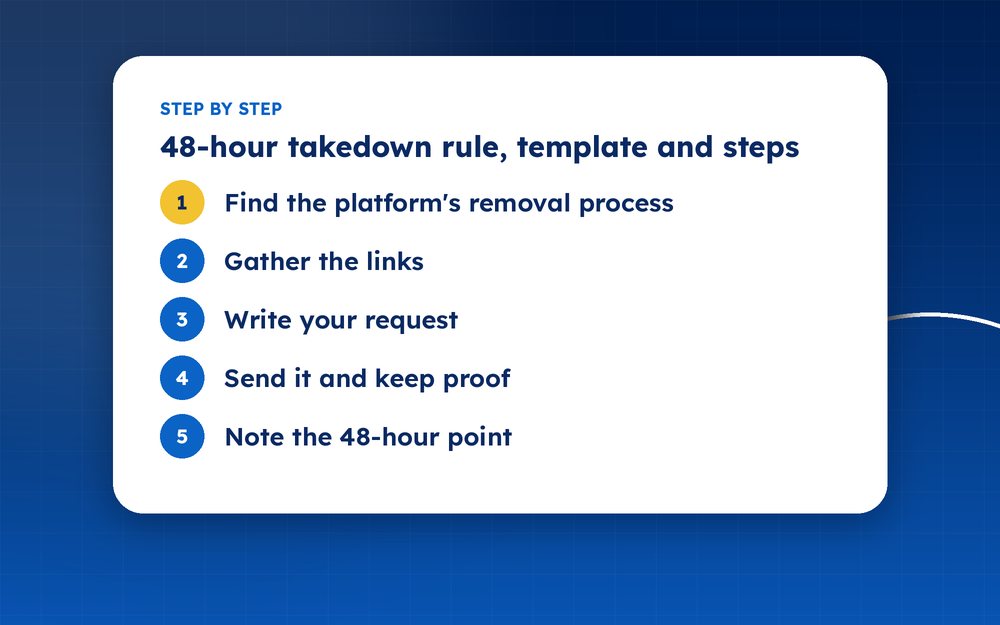
- Find the platform's removal processLook for a notice and removal form or contact on the platform, often in its help centre or legal pages. Look for the platform's non-consensual intimate imagery form or removal process. Covered platforms are expected to have a clear way to make requests.
- Gather the linksCopy the exact web address of each place the image or video appears. List the exact addresses of each post or image. Include screenshots as backup.
- Write your requestInclude your signature (typed is usually accepted on forms), identification of the content and where it is, a statement of good faith belief that it is an intimate image shared without consent, and your contact details. State that the image is an intimate image published without your consent, say who you are or who is acting for you, and ask for removal. Include a signature and contact information.
- Send it and keep proofSubmit through the platform's form or contact, and save a screenshot, confirmation and the time you sent it. Keep a copy of what you sent, with the date and time, and any confirmation or reference number.
- Note the 48-hour pointWrite down when the 48 hours end. Check whether the content is gone and whether identical copies were removed. Note when 48 hours have passed. The rule expects covered platforms to remove content within that period after a valid request.
- Follow up if neededIf nothing happens, send a reminder quoting your earlier request and the date. If nothing happens, follow up by quoting your first request and the time that has passed.
- Report non-complianceIf a covered platform still does not act, you can report it to the FTC through its reporting page for this law. If the platform still does not act, you can report non-compliance to the authority named in the rule, and a lawyer can advise.
A simple request template
Subject: Request to remove non-consensual intimate image under the TAKE IT DOWN Act.
Body: I am the person depicted in the content at the following addresses: [links]. This content shows me in an intimate setting and was shared without my consent. I have a good faith belief that it is a non-consensual intimate depiction. Please remove it and any identical copies on your service within 48 hours. My contact details are [email]. Signed: [your name].
Adjust the wording to the platform's form, and keep it short and factual.
What the law does not do
It is not a guarantee that every copy online will disappear. It covers covered platforms and identical copies they know about. It does not cover every website, every country or every type of content, and it does not directly remove results from search engines. You will usually still need search engine requests and reports to other sites.
Using the request outside the United States
If a platform operates in the US, it may follow the process worldwide for the content you report, but this varies. If you are elsewhere, use the platform's ordinary non-consensual image report, and check local rules. Many countries have their own regulators and reporting routes.
What a typical case looks like
A person finds an intimate image on a social platform and submits a request through its form, with the link, her details and a short statement. She notes the date and time. Within a day the platform removes the post and confirms by email. Had it not acted after 48 hours, she would have followed up, and reported non-compliance to the regulator.
Keeping a record of the time made any follow-up simple.
Common mistakes to avoid
Do not send a long emotional message instead of the key details. Do not forget the signature or contact details. Do not rely only on email if the platform has a form. Do not forget to save proof of when you sent it.
How a specialist can help
Preparing valid requests for many platforms, tracking deadlines and following up can be time-consuming. A specialist team can prepare and send requests and track the outcomes on your behalf. We are not a law firm and cannot give legal advice, but we can handle the practical side. Email us in confidence.
Frequently asked questions
Does the 48-hour rule apply to every website?
No. It applies to covered platforms under the Act, and many small or foreign sites ignore such requests. Other routes then matter.
Who can make a request?
The person shown, or an authorised person acting for them. Check the platform's process for what it requires.
Does it cover AI-generated images?
The Act addresses certain digital forgeries as well as real images. Check the current wording and platform rules.
What happens if the platform ignores me?
You can report non-compliance to the FTC and use other routes such as hosts and search engines.
Is this legal advice?
No. It is general information. For advice about your rights or a claim, speak to a qualified lawyer.
Does it remove the content from Google?
Not by itself. Submit a separate request to Google and other search engines.
Need help with this?
Every situation is different. Email us the details in confidence and we will reply with an honest assessment of what can be done.
Contact us by email NCII removalThis guide is general information, not legal advice. DMCA Reputation is not a law firm.
Related guides
Intimate Image Abuse Laws by Country: US, UK, EU, Canada, Australia and Singapore
An overview of intimate image abuse laws in the US, UK, EU, Canada, Australia and Singapore, and how they affect getting content removed. General information only.
Read the guide · 4 min
How to Report Intimate Image Abuse to the Police and What Evidence to Bring
How to report intimate image abuse to the police: what to say, what evidence to bring, how to protect yourself and how reporting fits with removal. A calm, practical guide.
Read the guide · 4 min
How to Remove Non-Consensual Intimate Images (NCII), Step by Step
How to remove non-consensual intimate images (NCII): reporting, StopNCII.org, Google removal, legal options and support. A step-by-step guide.
Read the guide · 4 min