
If a host does not respond, you are not out of options. A clear follow-up and escalation to the providers above the host usually gets attention.
Some hosts respond within hours, others take weeks, and a few ignore notices. Before escalating, make sure your notice was valid, sent to the right contact and clear.
Then move up the chain: reseller hosts, upstream network providers, content delivery networks, registrars, payment providers and search engines.
Silence is common, and it does not mean your notice was weak. Hosts receive many notices, and some deliberately delay. A calm escalation plan usually works better than repeating the same email.
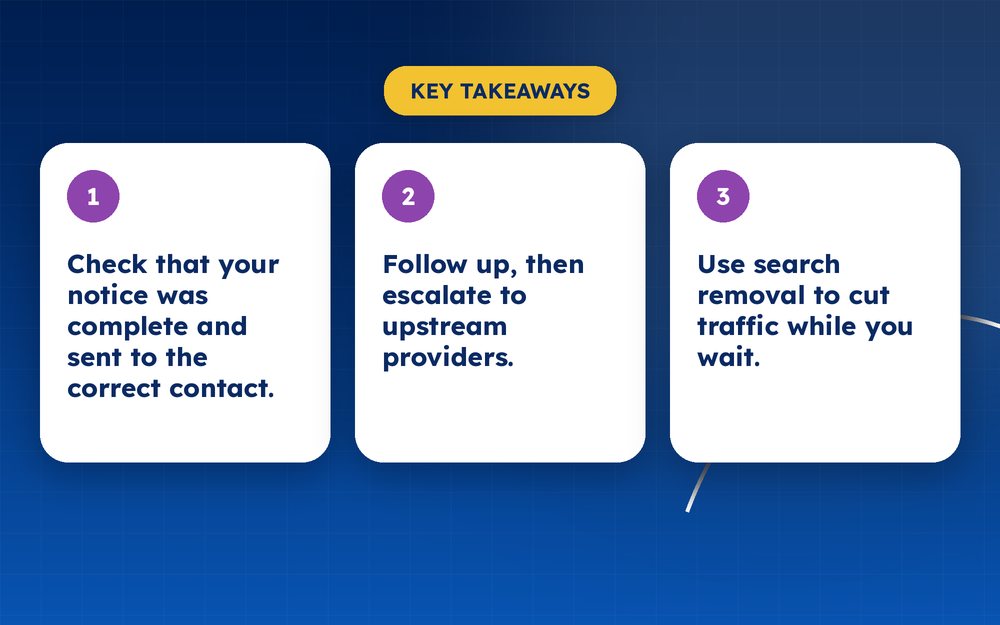
- Check that your notice was complete and sent to the correct contact.
- Follow up, then escalate to upstream providers.
- Use search removal to cut traffic while you wait.
What to do, step by step
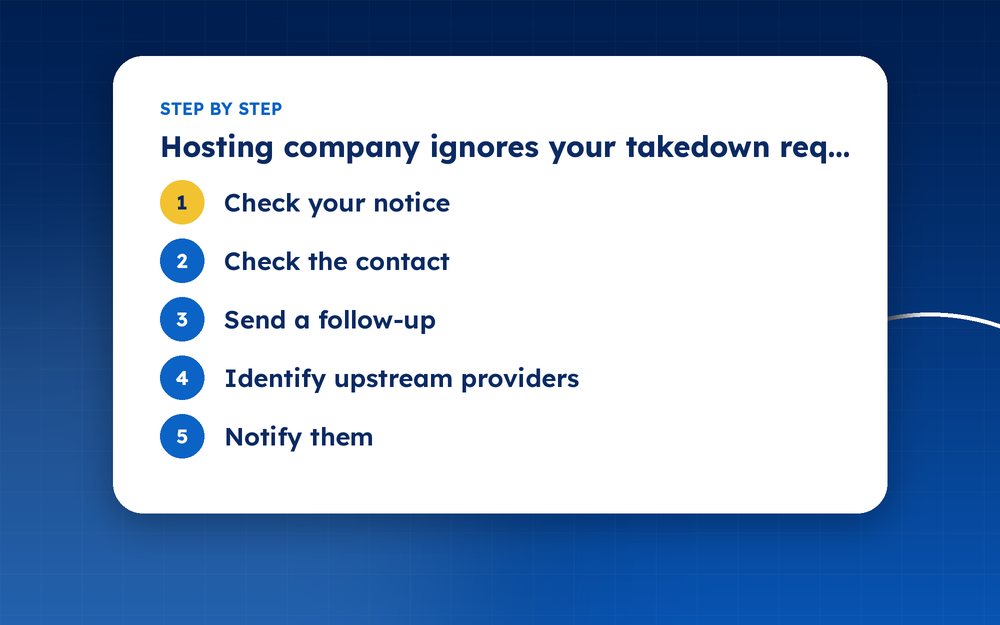
- Check your noticeMake sure it identified your work, the links, your contact details and the required statements. Check whether your notice had all required elements, correct links and a valid signature. Fix and resend if anything was missing.
- Check the contactConfirm you used the host's abuse or copyright contact. Confirm that you used the host's official abuse or copyright contact. Sending to the wrong address is a common reason for no response.
- Send a follow-upAfter a week or so, send a reminder quoting your earlier notice. After a few working days, send a short follow-up quoting your first notice and any reference. Keep the tone polite.
- Identify upstream providersLook up the network, CDN and reseller details. Use lookup tools to find upstream providers such as a content delivery network, an IP provider or the registrar.
- Notify themSend notices to those providers with your evidence. Send notices to those providers with your evidence and the history of your earlier notice.
- Ask search engines to remove linksSubmit requests for each page. Submit the links to search engines, so traffic reduces while you wait.
- Consider legal adviceFor persistent non-compliance, ask a lawyer about options. If the content is serious and the host will not act, a lawyer can explain options such as court orders. Keep records for them.
Why hosts ignore notices
Some hosts operate in places with weak enforcement, others use automated inboxes that no one reads. Some treat requests as low priority. Clear, repeated and escalated notices make them harder to ignore.
The chain of providers
A site relies on several layers: hosting, network connectivity, DNS, CDN, registrar and payment services. Each can be a point of pressure, and many have their own abuse policies.
Keeping a record
Record every notice, date and reply. A record of repeated non-response supports escalation and any later legal steps.
Legal options
Where non-compliance continues, a lawyer can advise on court action in your location. We are not a law firm and cannot give legal advice.
What a typical case looks like
A creator sends a notice to a host and hears nothing for a week. She checks and finds she used a general support address, so she resends to the abuse contact. She also notifies the content delivery network, which responds the next day and disables the site. She submits the links to search engines to make sure they stop appearing.
Using the right contact and a second layer of providers solved it.
Common mistakes to avoid
Do not send threats. Do not skip the follow-up. Do not forget upstream providers. And do not give up after one attempt.
How a specialist can help
A specialist team can escalate through the chain, send notices to every layer and monitor results. We cannot promise every host will comply, but we will be honest about what is realistic. Email us in confidence.
Frequently asked questions
Why do hosts ignore notices?
Reasons include wrong contacts, incomplete notices, high volume or deliberate delay.
How long should I wait?
A few working days, then follow up.
Who else can I contact?
Content delivery networks, registrars, IP providers, advertisers and search engines.
Can I sue the host?
Possibly in some cases, but it is complex and costly. A lawyer can advise.
Will search engines still help?
Yes. They can remove results regardless of host response.
Is this legal advice?
No. It is general information, and laws differ by country. For advice on your situation, speak to a qualified lawyer.
Need help with this?
Every situation is different. Email us the details in confidence and we will reply with an honest assessment of what can be done.
Contact us by email DMCA takedown serviceThis guide is general information, not legal advice. DMCA Reputation is not a law firm.
Related guides
Cease and Desist for Content Theft: Template and Steps
Cease and desist for content theft: when to send one, what it should include, a simple template, risks and how it fits with DMCA notices. General information.
Read the guide · 4 min
How to File a DMCA Counter-Notice and When to Respond to One
How to file a DMCA counter-notice and when to respond to one: what it says, the timeline, risks, what happens next and why you should consider legal advice first.
Read the guide · 4 min
How to Send a DMCA Takedown Notice (With Template)
How to send a DMCA takedown notice: what to include, who to send it to, a free template, counter-notices and common mistakes.
Read the guide · 5 min